Strategy Byte 75 – Porter's Five Forces
Porter's Five Forces in two layers, business and financial, and how a systems lens shows who captures economic value in an industry.

Table of Contents
- Recap
- Porter's Five Forces
- Five Forces & Systems Thinking
Recap
During Week 74, we discussed the definition of Industry - An industry refers to a specific group of companies that operate in a similar business sphere & have similar business activities.
Companies in a particular industry often respond in similar ways to macro economic & other external environment factors.
Then we rolled up industries to define a Sector - which refers to a part of the economy into which various industries consisting of a greater number of companies can be fit, & is larger in comparison. (E.g., transportation sector includes automobile, airline & trucking industries).
Then we answered the question - What is Industry Analysis?
It is a market assessment tool used by businesses & analysts to understand the competitive dynamics of an industry. It helps them to get a sense of what is happening in an industry, for e.g., demand-supply, degree of competition etc.
For ease of understanding, we introduced two layers in Industry Analysis as below :

Layer - 1 : Business or Non-Financial Layer
This layer involves understanding at a minimum
- The industry structure - meaning how the industry is structured from beginning to end in the value chain
- Who are the players in the industry?
- At what stage is the industry in - is it growing, matured or in decline?
- Who are the competitors within the industry? What are their likely reactions to new developments in the market?
- What are the regulations governing the industry?
- What are the customer segments & how do these segments impact products or services provided that industry?
- What value add are these products or services providing to customers?
Layer - 2 : Financial Layer
This layer involves understanding at a minimum
- The unit economics of the industry - which means the cost & revenue patterns in that industry & the business drivers behind those patterns
- The margins earned by the players in the value chain & the potential for sustaining or improving these margins
- Which players in the value chain capture the value generated across the value chain?
Then we explored the required mental framework to understand the intricacies of industry analysis - Systems Thinking
How is Systems Thinking relevant to Industry Analysis? Let us explore by understanding Porter's Five Forces
Porter's Five Forces
Porter's Five Forces is a framework for understanding the competitive forces at work in an industry, & which drive the way economic value is divided among industry actors (Source : here)
The key words to understand here are :
- Understanding the competitive forces at work in an industry &
- How it drives the way economic value is divided among industry actors
Before we explore the above, let us consider the analogy of driving.

When we drive, we not only focus on our driving but also the other cars in our vicinity. Are they driving too close? Will they turn to my lane soon? Are they driving too fast or too slow? etc. We then adjust our driving accordingly to ensure safety.
With that in mind, let us explore the above two points.
Understanding Competitive Forces
A company does not function in a vacuum. Understanding the competitive forces means understanding the lay of the land or the forces driving the industry along with it's players (means competitors, suppliers & customers).
It is a mandatory initial step. Without knowing the environmental factors driving the industry & the key players, their products, positioning & strategy, a company cannot develop a strategy to survive & thrive in that environment.
It is important to analyze your positioning vis-a-vis the other players in the industry. The following questions are worth pondering :
- Whether the current positioning & strategy is the most optimal from growth perspective?
- What can prevent growth?
- Who are the other players in the industry & what actions can they do to impact your businesses or vice versa? There could be a handful of companies or the number of players could be large.
This is also in line with Roger L Martin's "Where to Play" & "How to Win" part of the Strategy Choice Cascade. The environment (Where to Play) & the interactions determine what choices or trade offs a company makes to drive & achieve it's strategy (How to Win). (Source : Playing to Win by Roger L Martin)
Capturing Economic Value
Who captures the maximum value generated in that industry? Is it the industry players? The suppliers or the customers?
For e.g., Are all companies using the same supplier? If yes, how does this fact impact the cost of supplies? Do the suppliers wield enormous power over the companies? In terms of economic value capture, are the suppliers powerful enough to capture a good part of the economic value from you by charging higher prices for supplies?
What about customers? What are their behavior & to which segment they belong - low income, high income, middle class etc? Are these customers loyal exclusively to your products & services?
Porter's Five Forces tries to capture these relationships & interactions to identify which of these impact a company more so that it can position itself better to capture maximum value.
Let us now visualize Porters' Five Forces :
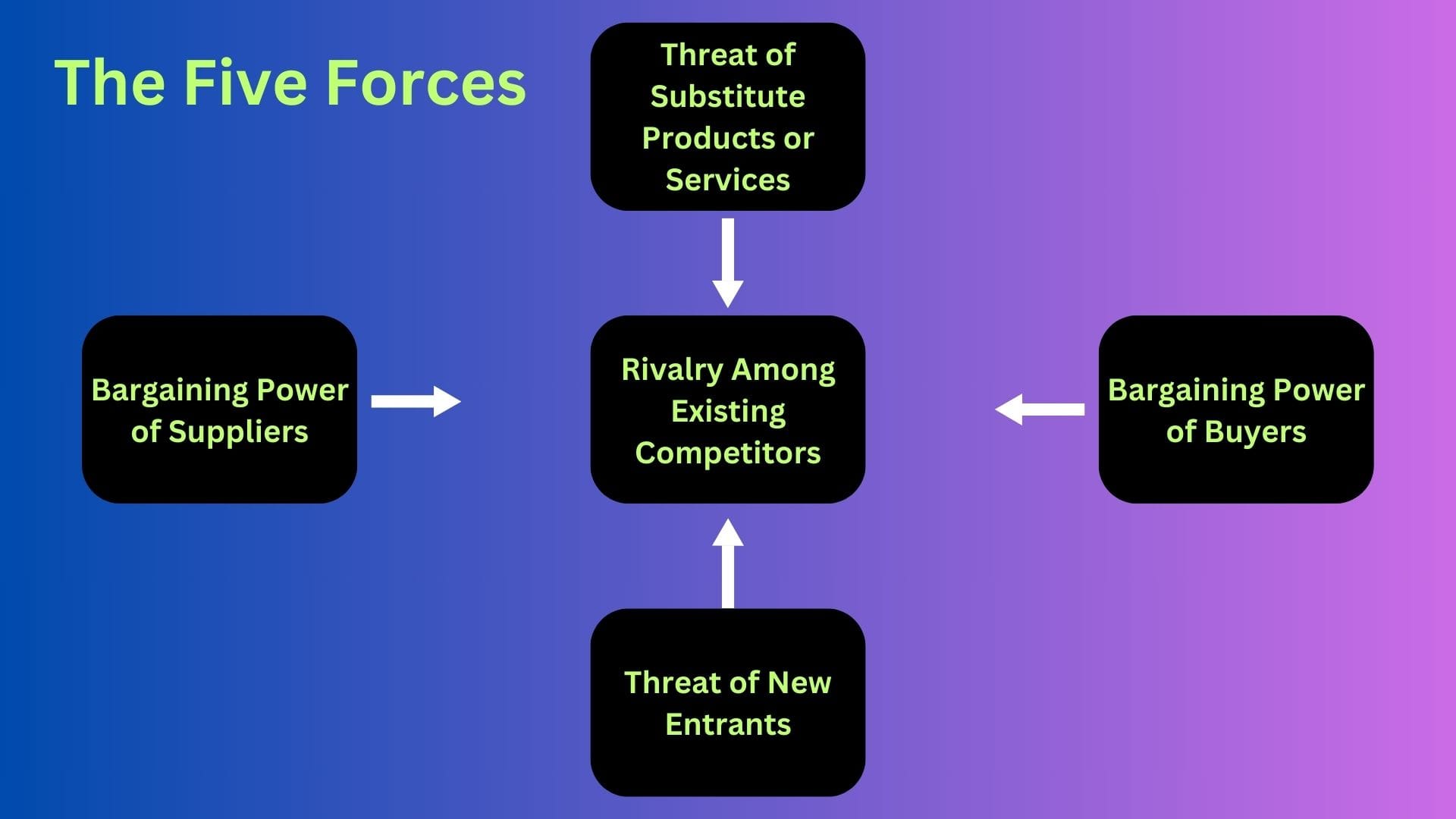
There are five forces surrounding a company's external environment which impact's it's strategy :
- Rivalry Among Existing competitors
- Bargaining Power of Suppliers
- Bargaining Power of Buyers
- Threat of New Entrants
- Threat of Substitute Products or Services
To make it more easy to understand, let us take an example which we discussed in Week 45 of a chef running a gourmet burger stall at a food festival:

He or she has to take into consideration the below points when setting up the stall (Relevant Five forces highlighted):
- He or she will have suppliers who provide the raw materials, equipment & consumables required to make burgers, fries etc. Can he or she negotiate with them for better terms? - Bargaining Power of Suppliers
- Some or all of the stalls may have a single supplier or different suppliers. What leverage the stall owners have with the supplier(s)? - Bargaining Power of Suppliers
- There will be other fast food stalls maybe close by or far away from our chef's food stall. Are their burgers better than ours? Where should we put our stall? - Rivalry Among Existing Competitors
- How is the competition between the stall owners? - Rivalry Among Existing Competitors
- Are there first time stalls of other chefs who makes gourmet burgers & fries like our chef? - Threat of New Entrants
- What are the alternatives a customer will go for other than burgers & fries (pizza, KFC etc)? Are there any stalls of those alternative cuisine close by? - Threat of Substitute Products
- Can our chef price their burgers to earn a reasonable profit by negotiating with suppliers along with other stall owners who together form a group? - Bargaining Power of Buyers
What has this to do with Systems Thinking?
Five Forces & Systems Thinking
Under Systems Thinking, a system consists of :
- Elements
- Interconnections &
- A Purpose
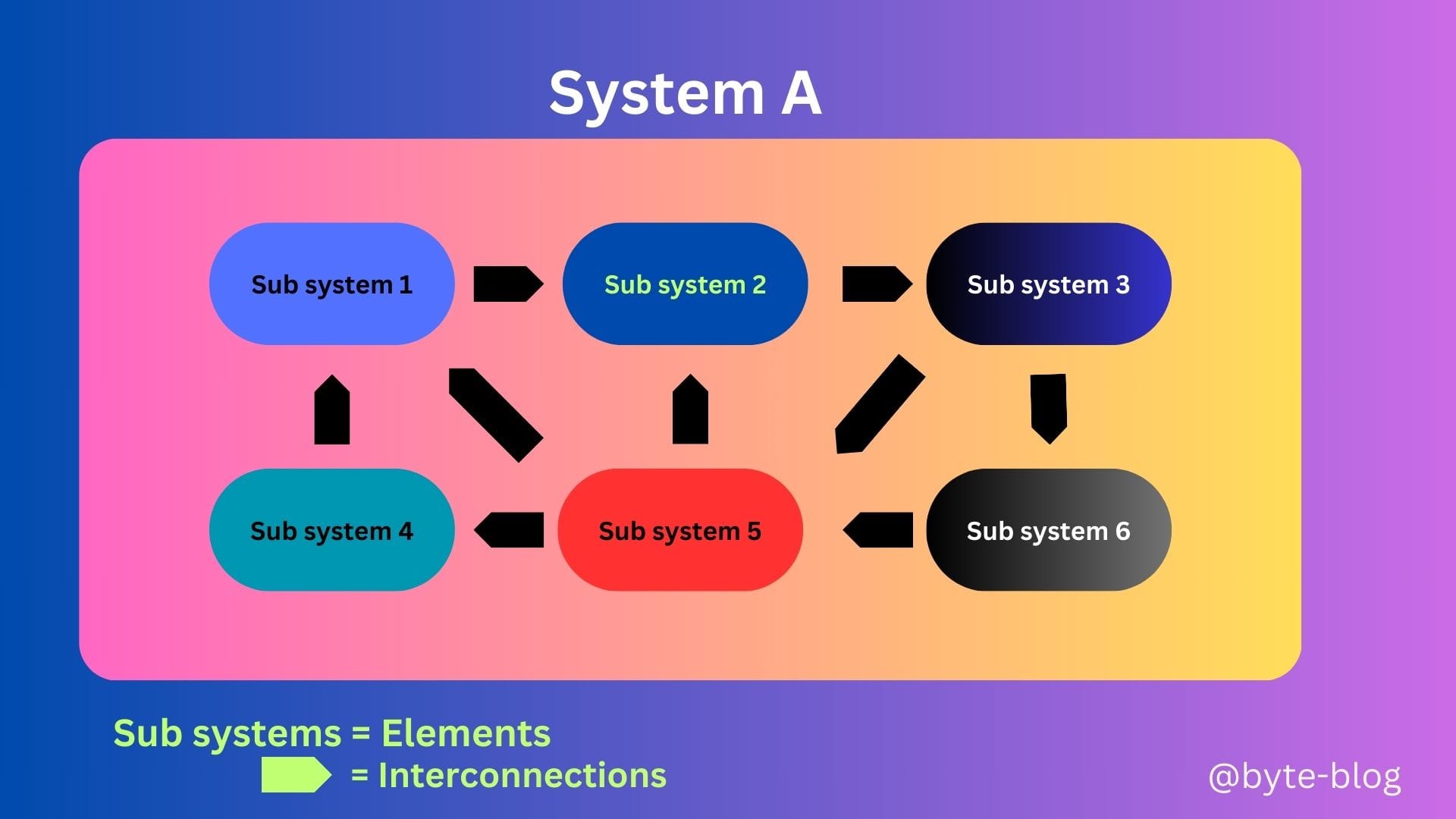
We can think of an industry as a system consisting of :
- The company
- Suppliers
- Competitors
- Customers
- Products
All of them interact with each other to serve customers & in turn generate returns in excess of their cost of capital ( or value). How they position themselves relative to each other determines how much value each of them capture from being in that environment.
A company's strengths & weaknesses are it's profile of assets & skills relative to competitors, including financial resources , technological posture, brand identification & so on. (Source : Competitive Strategy by Michael E Porter).
It is important when doing industry analysis to
- Identify the players (Suppliers, competitors, customers)
- Identify the interactions & their positioning or power over one another to see who captures the maximum value out of the business.
Thus we can see Layer 1 (Business or Non-Financial Layer) impacts Layer 2 (Financial Layer).
Let us dive deep next week:
