Strategy Byte 87 – Automotive Industry Structure
Mapping the automotive industry with Mauboussin's framework: upstream inputs, carmakers, downstream retail and adjacent industries, plus 2025–26 regulation.

Table of Contents
- Recap
- Concept
- Step 1 - Constructing Industry Map
- Step 2 - Economic Interactions
- Automobile Industry Map
- Regulators & the State
- Sources & Citations
Recap
During Week 83, we started with the history of the automobile industry, the pioneers who started it all. Then, we explored the evolution of the industry over the decades from 1900s to 2020s over Weeks 84, 85 & 86. This gave us an idea of the issues which shaped the industry over the past decades leading it to where it is now.
This week, we explore the automotive industry structure.
Concept

Every industry has a structure. What does it mean? It means if we think from the perspective of Input -> Process -> Output, an industry is structured in a way that there are
- Suppliers of input which provides input through raw or intermediate materials or services,
- The companies within the industry processing input to produce output for customers.
- Customers who are recipients of the output produced by the industry.
Then, there are adjacent industries which is related to the main industry in some way.
Relating this to Value Chain (from Michael Porter) in Week 82 which is about visualizing the activities in an industry as below :
- Input Activities - related to procuring inputs, supplier relations etc (Inbound Logistics)
- Transformation Activities - Transforming inputs to outputs or finished products taking place within the firm or enterprise (Operations)
- Output Activities - Moving the outputs or finished products to customers (Outbound Logistics, Marketing & Sales, Service)
Michael Mauboussin takes this one step further in his seminal essay "Measuring the Moat" by providing the below steps :
- STEP 1 - Construct an industry map
- STEP 2 - Understand the nature of economic interactions between the organizations on the map
- STEP 3 - Understand how the economic profit is distributed among the participant organizations.
Step 1 - Constructing Industry Map

An industry map gives the lay of the land as:
- Who are the participants (firms, suppliers, customers, regulators etc) in the industry layout
- Suppliers who provide the firm with inputs are typically on the left side of the map
- Customers, the purchasers of goods & services are on the right.
- What are the economic interactions between these participants? We also consider factors such as governmental regulations, tariffs & labor market etc.
- The underlying economic & other factors contributing to those interactions &
- How do these activities convert to economic profit & how is it divided amongst participants?
Step 2 - Economic Interactions
The interactions between the players in an industry drive transactions & those transactions drive income & expenses. These in turn drive the unit economics of the industry.
So, identifying inter-relationships between the players in an industry is crucial & that starts with having an understanding of the industry structure & how each player is positioned within that industry.
With the above concepts & understanding, let us dive deep into the automobile industry structure
Automobile Industry Map
Let us first visualize the industry map as below :
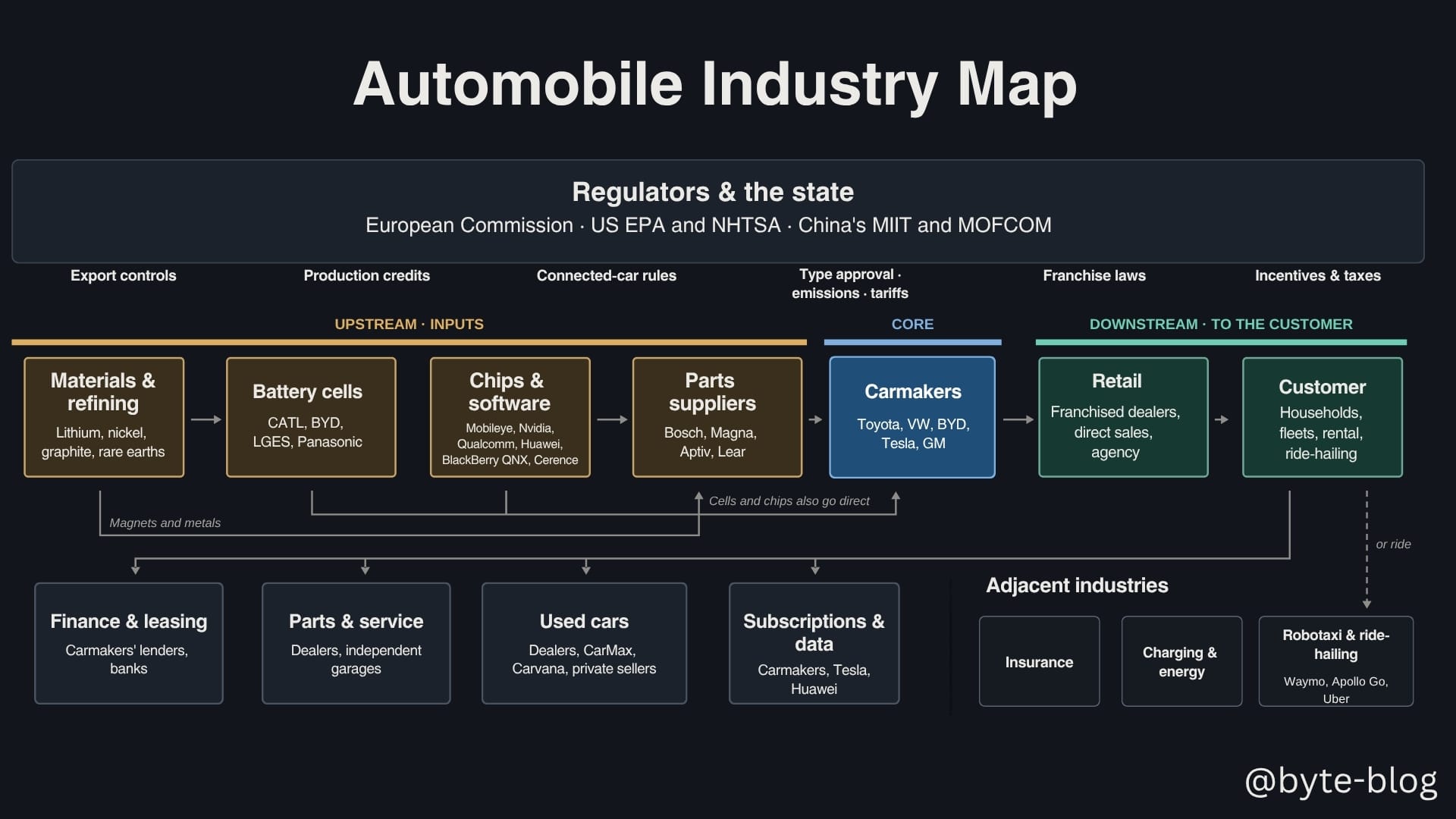
The industry structure follows the logic discussed above where we divide the structure into :
- Upstream - Inputs which focusses on the suppliers of inputs for the purpose of making an automobile
- Core - Making of the automobile
- Downstream - To the customer which focuses on the aspects post sales
There is a section for adjacent industries where ancillary services are provided by other industries to the automobile industry or customers. Let us deep dive into each part
Regulators & the State

On the top are the regulators & the State which regulates the industry. Automobile sector is a regulated industry to ensure the vehicles are in line with safety & emission regulations as it involves peoples' lives & the environment. We will discuss regulators at a high level under the below headers :
- Major regulators
- Major types of regulations
- Major Regulations passed in 2025 & 2026
Major Regulators
The major regulators for US, EU & China and what they regulate are as below :
- US:
- EPA: emissions and greenhouse-gas rules.
- NHTSA: fuel economy (CAFE) and safety.
- Congress: tax credits, CAFE penalties, California's waiver.
- California: its own clean-car rules (ACC II).
- The White House: tariffs under Sec. 232, Sec. 301 and Sec. 122.
- EU: the European Commission sets CO2 fleet targets, Euro emissions standards and type approval, and runs trade cases such as the duties on Chinese EVs.
- China:
- MIIT: industry rules, the NEV credit mandate and vehicle standards.
- MOFCOM: trade, export licences and talks with the EU.
- MOF/STA: the purchase tax on new vehicles.
I've not included corporate law or securities regulations for this blog which is focused on industry specific regulations only.
Major Regulation Types
Major regulation types at a high level are as below :
- Emissions and fuel economy, often with tradable credits.
- Safety and type approval, now extending to driver assistance and self-driving.
- Trade: tariffs, duties on Chinese EVs, minimum-price deals, export licences and export controls.
- Subsidies and taxes: purchase credits and tax breaks.
- Industrial policy: production credits, JV ownership caps, state ownership.
- Connected-car and data security.
- Market conduct: dealer franchise laws, and rules on how fast carmakers pay suppliers.
Major Regulations Passed (2025/2026)
2025
US
- Jan: the connected-vehicle rule, final from 17 Mar. It bans Chinese- and Russian-linked software from MY2027 and hardware from MY2030 (Model Year), and bars Chinese-controlled carmakers from selling connected cars in the US.
- 3 Apr: a 25% Sec. 232 tariff on imported cars, followed by parts. Trade deals later set Japan at 15% and cut Korea to 15% (Nov).
- Jun: Congress invalidates California's ACC II waiver, with court challenges still under way.
- Jul: CAFE penalties set to $0 under Public Law 119-21. EPA proposes removing the light-duty greenhouse-gas rules.
- 30 Sep: the $7,500 clean-vehicle credit ends.
EU
- 17 Jun: CO2 targets for 2025–27 can be averaged over three years (Reg. (EU) 2025/1214), and carmakers can pool emissions until the end of 2027.
- Dec: the 2035 target is proposed to soften to a 90% cut. It is still in the legislative process.
China
- 4 Apr: export licences required for seven heavy rare earths and magnets.
- Jun: 17 carmakers pledge to pay suppliers within 60 days, following the revised rules on paying small firms on time.
- 26 Sep: announces export licences for pure EVs, starting 1 Jan 2026.
- 31 Dec: automatic emergency braking (GB 39901-2025) becomes mandatory from 1 Jan 2028.
2026
US
- 18 Feb: EPA rescinds the 2009 endangerment finding and all vehicle greenhouse-gas standards, effective 20 Apr.
- Feb: the Supreme Court strikes down the IEEPA tariffs, and a 10% global Sec. 122 tariff follows from 24 Feb. The Sec. 232 car tariffs are unaffected.
- Pending: the SAFE III fuel-economy proposal, which would add 0.5% a year to MY2026 and 0.25% a year to MY2031, end credit trading and leave EVs out of compliance. The Tier 4 pollutant rules are proposed to be delayed to MY2029 (Model Year).
EU
- 12 Jan: guidance agreed with China's MOFCOM on minimum-price deals in place of the EV duties.
- 11 Feb: first deal accepted, for VW Anhui's Cupra Tavascan, which avoids a 20.7% duty.
- Jun: duties on Chinese plug-in hybrids being prepared, naming BYD, Chery and SAIC.
- 29 Nov: Euro 7 starts for new car types. It covers brake particles and battery durability, and applies to all new vehicles from Nov 2027.
China
- 1 Jan: export licences start for pure EVs, and the NEV purchase-tax break is halved to 5% for 2026–27.
- Aug: a safety standard for Level 3 and 4 self-driving (GB 44721-2026), effective 1 Jul 2027.
Sources & Citations
2025
US
- Connected-vehicle rule (final 16 Jan, in force 17 Mar)
Federal Register 2025-00592 - 25% Sec. 232 tariff on imported cars (from 3 Apr)
White House proclamation, Mar 2025 · Import offsets: Federal Register 2026-15280 · Japan 15%: EO 14345 · Korea cut to 15%: Korea Times, 29 Jan 2026 - California ACC II waiver invalidated (Jun); EPA proposal to remove GHG rules (Jul)
GM 10-K 2025 (company filing) - CAFE penalties set to $0 (PL 119-21, §40006)
Federal Register 2025-22014 - Clean-vehicle credit ends after 30 Sep
IRS
EU
- CO2 targets averaged over 2025–27 (Reg. 2025/1214)
EUR-Lex - 2035 target proposed at a 90% cut (Dec)
European Commission, DG CLIMA
China
- Rare-earth export licences (4 Apr)
CSIS, 14 Apr 2025 - 60-day supplier payment pledge (Jun)
CnEVPost, 11 Jun 2025 · Geely 2025 results - Export licences for pure EVs announced (26 Sep)
CnEVPost, 26 Sep 2025 - Mandatory emergency braking, GB 39901-2025 (approved 31 Dec)
CnEVPost, 28 Jan 2026
2026
US
- Vehicle GHG rules rescinded (18 Feb, effective 20 Apr)
Federal Register 2026-03157 - IEEPA tariffs struck down; 10% Sec. 122 tariff from 24 Feb
Stellantis 20-F FY2025 (company filing) - SAFE III fuel-economy proposal
Federal Register 2025-22014 - Tier 4 pollutant rules delayed to MY2029 (proposed)
Federal Register 2026-09905
EU
- Minimum-price guidance agreed with China (12 Jan)
CnEVPost, 12 Jan 2026 - First minimum-price deal, Cupra Tavascan (11 Feb)
CnEVPost, 11 Feb 2026 - Duties on Chinese plug-in hybrids being prepared (Jun)
CnEVPost, 20 Jun 2026 - Euro 7 starts for new car types, 29 Nov (Reg. 2024/1257)
EUR-Lex
China
- NEV purchase-tax break halved for 2026–27
MOF/STA/MIIT Announcement 2023 No. 10 - Export licences for pure EVs start (1 Jan)
CnEVPost, 26 Sep 2025 - L3/L4 self-driving safety standard, GB 44721-2026 (effective 1 Jul 2027)
CnEVPost, 4 Aug 2026