Strategy Byte - Week 65 The Journey so Far Part V

Table of Contents
- Recap
- Interest Rate Drivers
- Supply & Demand
- Central Banks - OMO
- Central Banks - Reserve Requirements
- Central Banks - Discount Window
- Central Banks - Set Base Rates
- Central Banks - Forward Guidance
Recap
We continue our journey to understand strategy by looking back & reviewing our steps which will help us to gain perspective on the subject & also guide us moving forward.
Last week we reviewed Term Structure or Yield Curve which is defined as the relationship between the remaining time-to-maturity of debt securities & the yield on those securities.
We then went on to define "Debt Security" & a "Bond" after which we explored the Bond market along with it's impact on the world economy.
Then we explained different types of yield curve :
- Upward sloping or Normal Yield Curve
- Flat Yield Curve &
- Inverted Yield Curve
How does a yield curve help? It provides signals on:
- Economic Outlook - depending on the type of yield curve signalling the direction of interest rate movement &
- Market Expectations - when a yield curve reflects market expections of future interest rates providing insights into the investors' minds & their outlook on the economy.
This week, we move forward with the environmental variables that drive interest rates.
Interest Rate Drivers
The major drivers of interest rate are :
Supply & Demand
The primary definition of interest rate is that it is the cost of money.
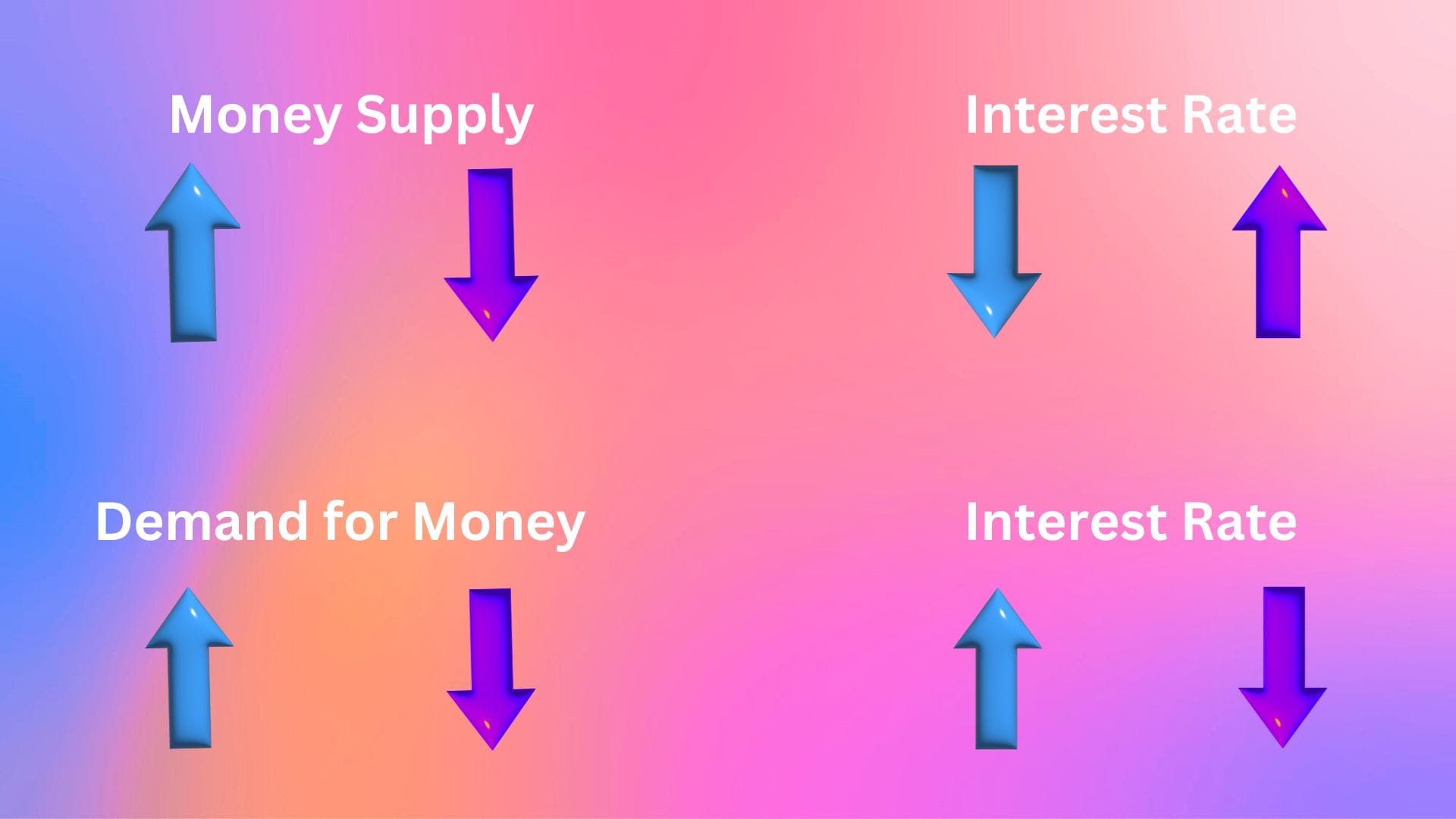
What do we use money for? Primarily for lending, borrowing & investing along with transacting. Supply & Demand for money determines the cost of money viz., interest rates.
When there are lots of money floating around (or in other words - higher liquidity), there is more cash to lend, borrow or invest in line with demand.
In such a scenario, acquiring money will be easier & hence interest rate which is the cost acquiring this easily available resource will come down.
Imagine the opposite scenario when there is less money floating around (or in other words - lower liquidity or illiquid), there is less cash to lend, borrow or invest. In such a scenario, acquiring money will be tougher & hence interest rate, which is the cost of acquiring this scarce resource, will go up.
Irrespective of liquidity, if there is no demand or avenues to put the money to good use, then also interest rates will come down.
Central Banks
Who controls the supply & demand of liquidity - Central Banks or Monetary Authorities in any economy. How do they carry out this mandate? Through one or more of the below modes :
2.1 Open Market Operations (OMO)
When the Central Bank, as part of it's monetary policy increases money supply, it injects liquidity into the economy causing interest rates to fall.
Conversely, when the Central Bank reduces money supply, it pulls out liquidity from the economy causing interest rates to rise.
This is done through Open Market Operations by buying or selling Government securities (Refer Week 23 for more details)
2.2 Reserve Requirements
Another way Central Banks control money supply is through banks by mandating Reserve Requirements. We explored the concept of Reserve Requirements in Week 24. Let us revisit it again,
Reserve requirements are central bank regulations that set the minimum amount that a commercial bank must hold in liquid assets. This minimum amount, commonly referred to as the commercial bank's reserve, is generally determined by the central bank on the basis of a specified proportion of deposit liabilities of the bank.
The above liquid assets can be maintained either with itself or with Central Banks. How does this impact liquidity?
Banks lend money to customers. Even though this is not directly linked to printing of money, money is created indirectly when such lending or credit creation takes place. Thus, reserve requirements limits the amount banks can lend to customers leading to scarcity in supply of money through reduced credit. How?
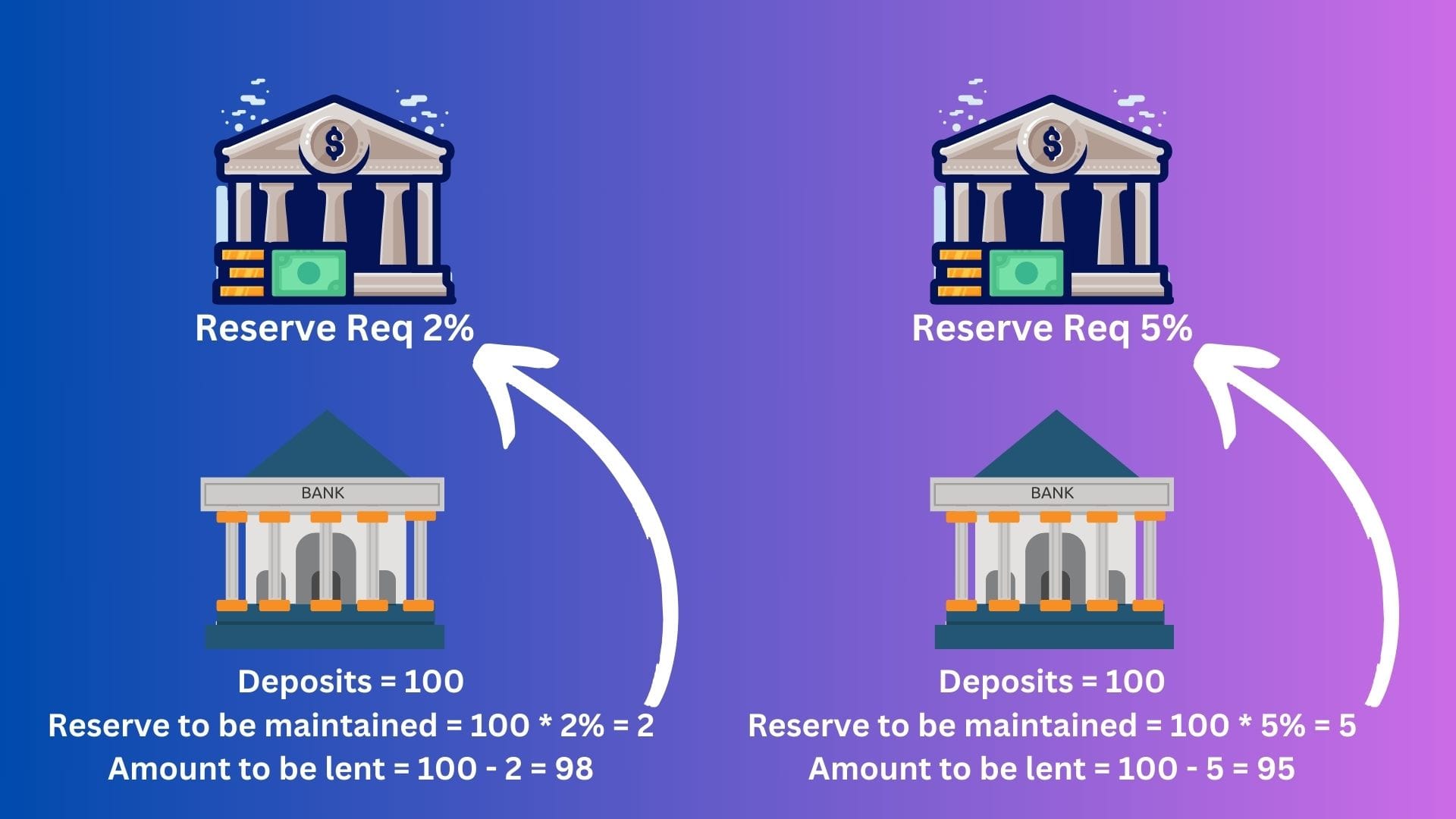
When higher reserve requirements are imposed on Banks by Central Banks, banks have to maintain higher balances with Central Bank reducing the amount lent to customers. Conversely, when reserve requirements are reduced, banks can lend more to customers creating more credit & resulting in higher money creation.
The below visual shows a comparison of the quantum of possible lending in different reserve requirement scenarios (2% & 5%) where higher reserve requirements result in lower lending:
2.3 Discount Window
Let us first understand what is the Discount Window facility offered by Central Banks to Banks. (Source : here)
The discount window is a central bank lending facility meant to help commercial banks manage short-term liquidity needs. Banks that are unable to borrow from other banks in the fed funds market can borrow directly from the Central Bank's discount window paying the federal discount rate.
Discount window borrowings tend to be short-term, usually overnight & collateralized. Banks borrow from the discount window when they are experiencing short term liquidity shortfalls & need a quick cash infusion. Hence, discount window borrowing tends to rise during spells of economy wide stress, when all banks are experiencing some degree of liquidity pressure.
The Central Bank adjusts this discount rate to manage liquidity & reserve requirements of Banks to control the money supply. For example, during the 2008 Financial Crisis, the Fed Discount window was used to maintain financial stability by extending lending period from overnight to 30 days & then to 90.
2.4 Set Base Rates
Central Banks can set & influence interest rates by modifying the base rate or the Fed funds rate depending on the economic situation. (Refer Week 23 for a more detailed explanation on base rates).
2.5 Forward Guidance & Perception
See the below statement from Federal Reserve (Source : here)
Dec 16, 2008 - The FOMC lowers it's target for the federal funds rate to a range of 0 to 1/4 percent, which the FOMC considers to be an effective lower bound. In addition, the Committee states that "weak economic conditions are likely to warrant exceptionally low federal funds rate for some time"
This shows the intention of the Federal Reserve to keep interest rates low in the near future. This helps set expectations & impacts behavior of the population towards investments, borrowing & savings further influencing rate behavior.
All the above are fine but what is the main consideration influencing Central Banks to raise or lower interest rates?