Strategy Byte - Week 73 - The Next Peak

Table of Contents
- The Next Peak
- The VR Headset
- Industry Analysis - Why do we care?
- Industry Analysis - Relevant
The Next Peak
During Week 72, we completed our revisit of macro economic variables which is something that we, as finance professionals need to keep an eye on & have the foresight to tackle any unexpected economic or geopolitical events which can impact liquidity, profitability or even the very sustainability of a company.
That means, it is important to have context behind the scenario planning models that we build to prepare for such events & not just build the model for the sake of itself. The assumptions behind those numbers are what drives decisions. We see data every single day - internal numbers as well as external. Understanding how they interact & impact the operations of a company or an industry is where we add value.
Moving on, we explored industry analysis from week 43 & did some high level analysis of the automobile industry. But after reading what I wrote before, I myself felt it dry & too technical. The points were important & followed a logical sequence. But it lacked a story. Every industry has a history, a story & a life cycle.
A company or industry is born like any of us. They live through various stages of their life cycle & ultimately decline or evolve into something different. Also, companies or industries don't exist in silos. They are affected by events in the external environment. Each industry reacts differently to external events. The way each industry reacts or prepares for external environment variables depends on the underlying structure of that industry & how that industry evolved over it's life cycle.
What made me think more on these terms ?? a VR headset.
The VR Headset

Last week, I bought a VR headset for my son on his birthday. Of course, it was my job to set up everything for him. He had a blast & loves it!!
One night, I watched a documentary in VR on evolution of life on earth where I was like standing right there in the midst of events related to evolution - starting from earth as a rock, to meteorite strikes, lifeless oceans, microbial organisms, plants, life forms, dinosaurs & ultimately mammals - right in front of me. It was an amazing experience!!
The striking thing about evolution is that there was a cataclysmic event like a meteor strike or volcanic explosion which decimated life or most of it at each stage & then new life evolved post that event.

It got me thinking that just like nature goes through different stages of evolution, industries are also in a constant stage of evolution or extinction - either prompted by internal factors like competition or forced by external variables (like technology) which can result in an entire industry being decimated as a result of disruption.
This is nature's motto - Evolve or Die
We are seeing this happening right in front our eyes & in our lifetimes where business models are constantly being tested & disrupted.
Industry Analysis
We will revisit some key points which we covered from Week 43 to Week 48 adding some nuances to our discussion surrounding the variables governing an industry, it's history, evolution to current state & it's potential for disruption.
It's going to be a long journey as we explore various industries. But first, let us tackle the context behind industry analysis. Why do we do industry analysis?

Why do we care?
Why do we care about industry analysis & how is it important to strategy?
As I mentioned above, a company exists in an eco-system where it interacts with other players (we will get into who are those players later!!) & it's actions are shaped by how other companies act.
Roger L Martin states as part of Strategy Choice Cascade, the process of strategy is to figure out "How to Win" in a chosen "Where to Play" area. This means understanding the unit economics of the industry along with the direct or indirect competitors which will give an idea of where a company is placed in the industry vis-a-vis their competitors.
Some key reasons to do industry analysis are :
- It reveals key advantages & constraints about the industry
- Analyzing a company's strength &/or weaknesses requires a baseline & industry analysis helps in determining that baseline. For e.g., product quality, pricing levels etc.
- Industry analysis guides strategic action in :
- Positioning a company & it's products keeping in mind it's competitive advantages.
- Guarding against disruptive forces bought about by competitors or external environment variables.
- Identifying customer segments to serve
- Identifying whether the industry itself is subject to disruption internally or from external environment variables like technology.
It is more like understanding the lay of the land & hence a key component of strategy.
Michael E Porter said it best -
"Every firm competing in an industry has a competitive strategy, whether explicit or implicit. Developing a competitive strategy is developing a broad formula for how a business is going to compete, what it's goals should be, and what policies will be needed to carry out those goals."
Also, he said -
"A company's strengths & weakness are it's profile of assets & skills relative to competitors, including financial resources, technological posture, brand identification & so on. The external limits are determined by it's industry & broader environment."
So, when a company enters or starts operations in an industry, the primary consideration should be around how the company positions itself vis-a-vis other players in the industry & that requires understanding the underlying industry structure - it's cost & revenue drivers, customer base etc. That in turn will drive the returns earned by the company over it's cost of capital.
Understanding an industry structure is very important as it creates the foundation against which a company creates value & frames it's strategy around it. And this structure is constantly changing & evolving which requires a company to be constantly reviewing it's strategy to see if it's WWHTBT (What Would Have To Be True) conditions are still met. (WWHTBT framework - from Roger L Martin).
Next, we explore for whom is industry analysis relevant?
Industry Analysis - Relevance
Another angle of looking at the WHY behind industry analysis is to see it from the perspective of to whom such analysis would be relevant.
We can classify the WHY under two perspectives :
- As an Operator
- As an Investor
What does this mean? Let us first understand what an Operator or Investor means?
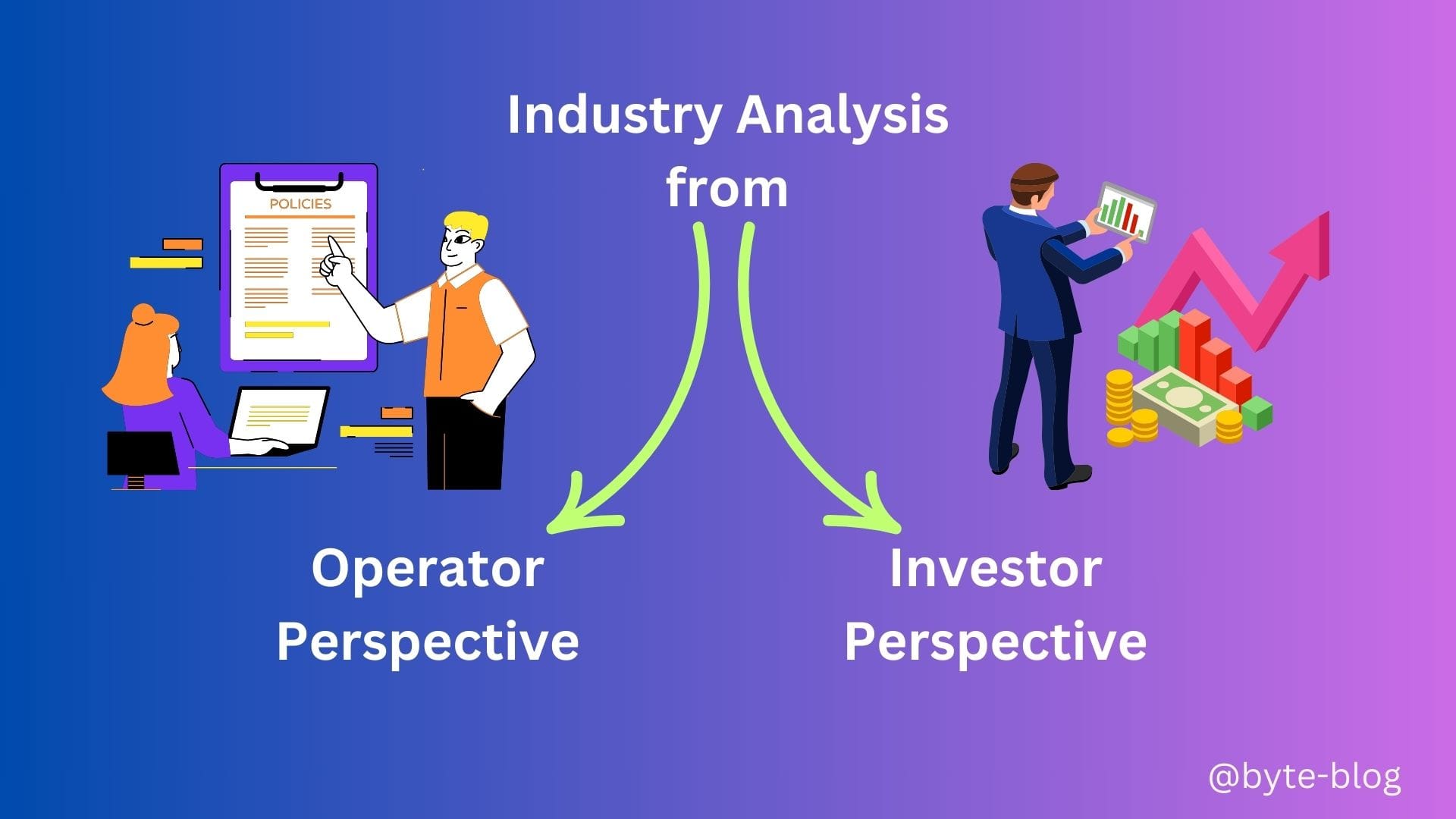
Operator
An operator is a business professional who oversees the general operations of a company on behalf of the business owner. They help the company interview and hire high-quality employees, develop processes and procedures for staff to follow, set strategic business goals and ensure the business operates smoothly.
Operators often analyze the effects of the business decisions they make. Then they make adjustments to the operating model as needed. These professionals often consult with business owners to review the performance of the company and make plans for improvement. (Source : here)
An operator is someone who runs the company in line with it's objectives & strategy. It can be a business owner or CEO, but not necessary to be an operator. For some companies, these responsibilities may lie with the COO (Chief Operating Officer). But it refers to someone who ensures smooth operations of the business & identify improvements in line with opportunities.
As an operator, understanding where the company stands in comparison with it's peers is very important. Some of the questions they have to tackle are :
- Is the company improving it's stand in the market?
- How are customers perceiving their products or services compared to their competitors'?
- What is the financial position of the company vis-a-vis their peers ?
- Are they managing their operations more efficiently compared to their competitors?
Hence, as an operator, being better than competition is what helps them to be in the market and run the operations in a VUCA (Volatile, Uncertain, Complex & Ambiguous) environment.
Investor
Investors are people or entities that risk their money in various financial assets or ventures with the expectation of earning a return, which they may or may not realize. (Source : here)
From the perspective of companies, investors provide them with capital to invest in their operations and depending on how much the company earns, these are either returned to investors through dividends or share buybacks or reinvested back into the company to maximize earnings to investors.
As an investor, understanding whether it is worth it to invest in a company is important. Some of the key questions they have to tackle are :
- Is the company performing at par, below or better than competitors ?
- What is the earning potential of the company & the industry?
- Based on the above, should I invest or not?
- If yes, how much money can I commit for the returns promised?
Now that we understand what an industry is and why industry analysis is a foundation for strategic direction, how do we actually do Industry Analysis?