Strategy Byte - Week 83 Automotive Industry - The History

Table of Contents
- Recap
- The Mobility Industry
- The History
- The Disruption
Recap
During Week 82, we took a deep dive into profit pools. We started at the surface level by understanding the activities underlying the value chain resulting in profits. We can visualize & divide the activities in an industry into :
- Input Activities - Related to procuring inputs, supplier relationships etc (Inbound Logistics)
- Transformation Activities - Transforming inputs to outputs or finished products taking place within the firm or enterprise (Operations)
- Output Activities - Moving the outputs or finished products to customers (Outbound Logistics, Marketing & Sales, Services)
All the activities in total (also called Primary Activities) add value by transforming raw inputs to finished output. There are secondary activities supporting the Primary Activities. This is what Michael Porter called "Value Chain".
Why is understanding these activities important ? - It helps us correlate the relationships among participants to whom these activities are distributed.
Then, we explored the three step process from Michael Mauboussin's Measuring the Moat write up as :
- Step 1 - Construct an Industry Map
- Step 2 - Understand the nature of economic interactions among the participants
- Step 3 - Understand how the economic profit is distributed among the participant organizations
Last, we ended with how this can be used to map the future of an industry. The question to ask is :
What if the map itself is changing through disruption or other economic & geopolitical factors?
If that is the case,
- Will the current activities contributing to economic profit exist in the next couple of years or decades or their contribution reduce?
- What are the activities which will contribute to economic profit in the future?
This analysis shows :
- how an industry is evolving &
- how the activity mix contributing to economic profit will evolve accordingly.
Let us take one industry & do a deep dive. We will again take the automobile industry. We discussed the automobile industry from Week 49 to Week 60. But I felt it could be improved with the frameworks that we discussed last couple of weeks. So, what are we waiting for.... Let's dive in!!!!

The Mobility Industry
What does mobility mean?
As per Merriam-Webster dictionary, the definition of Mobility includes :
- the quality or state of being mobile or movable &
- ability or capacity to move
Mobility refers to " the set of solutions that enable the movement of people and goods in an efficient, sustainable and accessible manner. It goes beyond simple physical transportation, encompassing technological, social and environmental aspects. In this sense, mobility is a multidimensional concept that is integrated with daily life, the economy and urban planning. "(Source : here).
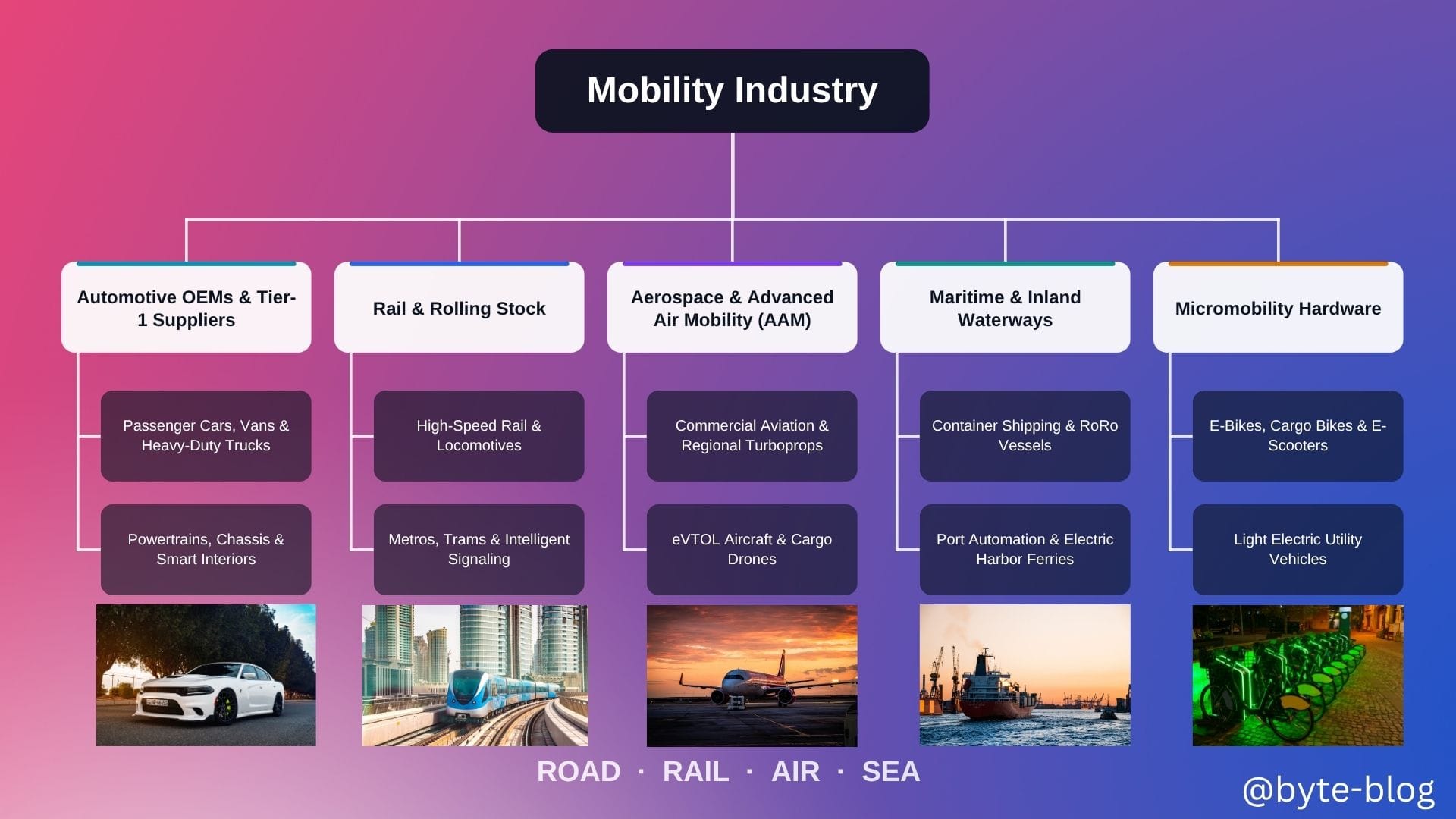
The Mobility Industry includes the below :
- Automotive OEMs & Tier-1 Suppliers: Passenger cars, commercial vans, and heavy-duty trucks, alongside chassis, powertrain, and interior systems suppliers.
- Rail : High-speed rail, locomotives, freight cars, metros, trams, and signaling systems.
- Aerospace : Commercial aviation, regional turboprops, unmanned aerial vehicles (cargo drones), and electric vertical takeoff and landing (eVTOL) aircraft.
- Maritime & Inland Waterways: Container shipping lines, bulk carriers, roll-on/roll-off (RoRo) vessels, automated port handling equipment, and electric harbor ferries.
- Micro-mobility Hardware: E-bikes, cargo bikes, e-scooters, and light electric utility vehicles.
How did this industry come into being? What is the reason for its existence? The reason is simple, to move someone or something from point A to point B. The term here is mobility.
Check out the video below :
The Mobility Industry
Hence, the automotive industry, along with ships, trains, trucks etc., forms part of the mobility industry.
This series focuses on one part of it: passenger vehicles, from the suppliers who make the parts to the dealers, lenders and service shops that sell, finance and maintain the cars.
The History
Before all the above, there were horse carts, bullock carts, horses which people rode to move from point A to point B.
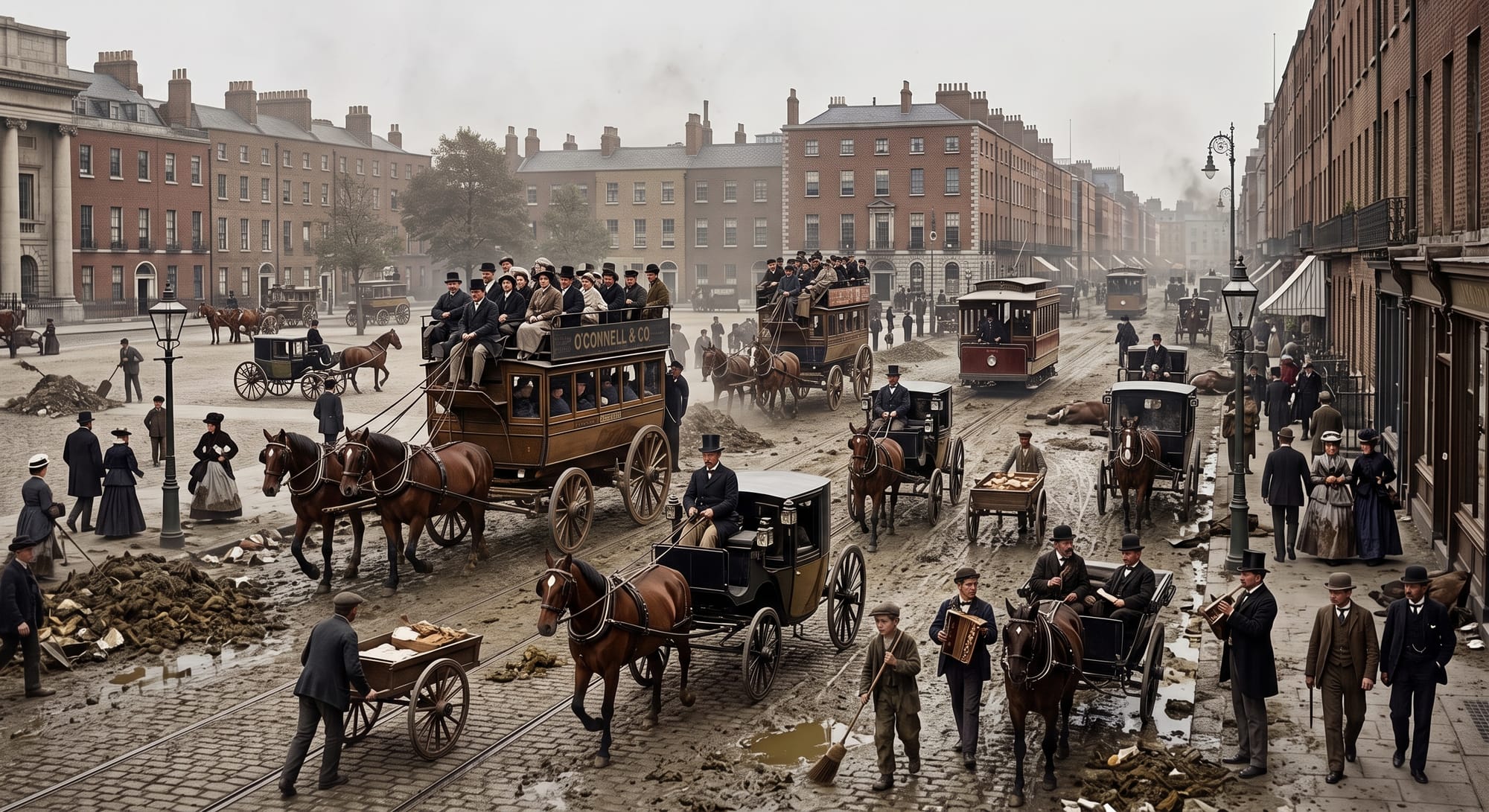
To move longer distances, railroads were the only other option. There are some interesting facts related to the horse-cart era. Enjoy the history!!
Fact : By the late 1800s, major cities like New York and London relied on large numbers of working horses daily, leading to severe sanitation and logistical issues:
- Daily Waste: Every working horse left manure and urine on the streets, every day.
- "Mud" in the Streets: During wet weather, rain combined with manure, dirt, and urine to create a deep, noxious slurry. Pedestrians paid "crossing sweepers" (often impoverished children) a coin to clear a narrow path across the street so they wouldn't ruin their boots and long skirts.
- Summer Dust & Disease: In dry weather, iron-shod hooves and steel carriage wheels pulverized dried dung into a fine powder that blew into eyes, lungs, and through open windows, contributing to respiratory illnesses, typhoid, and cholera outbreaks.
- Carcasses Left in the Open: Horses were driven relentlessly, and many dropped dead on city streets from exhaustion, heatstroke, or injury. Because a carcass was hard to move, bodies were often left to decompose along the curb for days before they were hauled away.
The Disruption
The below events led to the disruption of the carriage industry :
- The inventors: European inventor-engineers (Benz, Daimler) and French makers (Panhard et Levassor, Peugeot) built the first cars. The car "was initially perfected in Germany and France toward the end of the nineteenth century by such men as Gottlieb Daimler, Karl Benz, Nicolaus Otto and Emile Levassor" (Source : here).
- Technology: the light petrol engine. Carl Benz filed patent DRP 37435 for a "vehicle powered by a gas engine" on 29 January 1886, widely treated as the automobile's birth certificate (Source : here).
- The first modern car: The 1901 Mercedes, designed by Wilhelm Maybach for Daimler Motoren Gesellschaft, deserves credit for being the first modern motorcar in all essentials. (Source : here).
- France led early production: "from 1902-1907, France produced more cars than the rest of Europe combined", and "The United States did not out-produce France until after 1907" (Source : here).
- Manufacturing: Ford's moving assembly line (1913) cut Model T build time to about 90 minutes (Source : here). The Model T's price fell from $825 in 1908 to $260 by 1925 (same source; nominal USD).
- Scale : The industry scaled in the US, where Ford turned the car into a mass product. In 1921 Ford alone held 55.67% of the US market (Source : here).
Why did the car win? It came down to cost, and convenience. A car took people from place to place on their own timetable and once mass production made it affordable, the horse could not compete.
In 1900 the US had 2.94 million horses that were not on farms, and 8,000 registered automobiles. By 1920, horses not on farms had fallen to 1.71 million, while registered automobiles had risen to 8.13 million (Sources: here & here).
Next week, we explore the evolution of the Automobile industry.