Strategy Byte Week 80 - Industry Evolution

Table of Contents
- Recap
- Industry Evolution
- Pre-competitive
- Competitive
Recap
During Week 79, we tried to translate value to quantifiable numbers. What difference does it make if we cannot quantify the impact of strategic choices a company made? Is it actually delivering value & doing so in a way that is visible through numbers?
What does it mean?
To provide a framework to our journey, we started with two questions :
- How do we translate value to numbers?
- How will we know if the drivers of value are still working or not?
They key driver to remember is - The value provided to customer resulting in higher willingness to pay must be higher than the cost to provide that value.
But which number reflects the above - Gross Profit, Net Profit, Sales?
We then explored the above using Returns vs Cost (Research by Michael Mauboussin & Dan Callahan).
"The goal of a company is to identify & execute a strategy that gives it a competitive advantage that is sustainable. A company's anticipated Value creation is measured by
- how much it's return on invested capital (RoIC) exceeds it's cost of capital (WACC) as well as
- how long it can maintain a positive spread, a reflection of it's sustainable competitive advantage."
Thus, Value Creation = RoIC - WACC
Another important point to note is sustainable value creation is distinct from sustainable competitive advantage - where a company generates as RoIC over WACC that is also higher than that of it's competitors. That is where value creation of a company is reflected.
This value creation as well as it's consistency over a period is what translates to cash flow which is either
- Invested to grow (organically or inorganically) or
- Spent for maintenance or
- Returned to owners
This ultimately translates to company value or market capitalization where we quantify the cash flows a company will generate over a given period, when they may be received & discounting those cash flows at a discount rate to arrive at what the company is worth.
Then we we linked Apple's journey from 1980s, the strategies at various points in time, the customer value created & the financial outcome in terms of market capitalization & revenue.
Now, we will discuss two more concepts before we develop the framework for industry analysis
- Industry Evolution &
- Profit Pools
Industry Evolution
We all know about different stages of life.
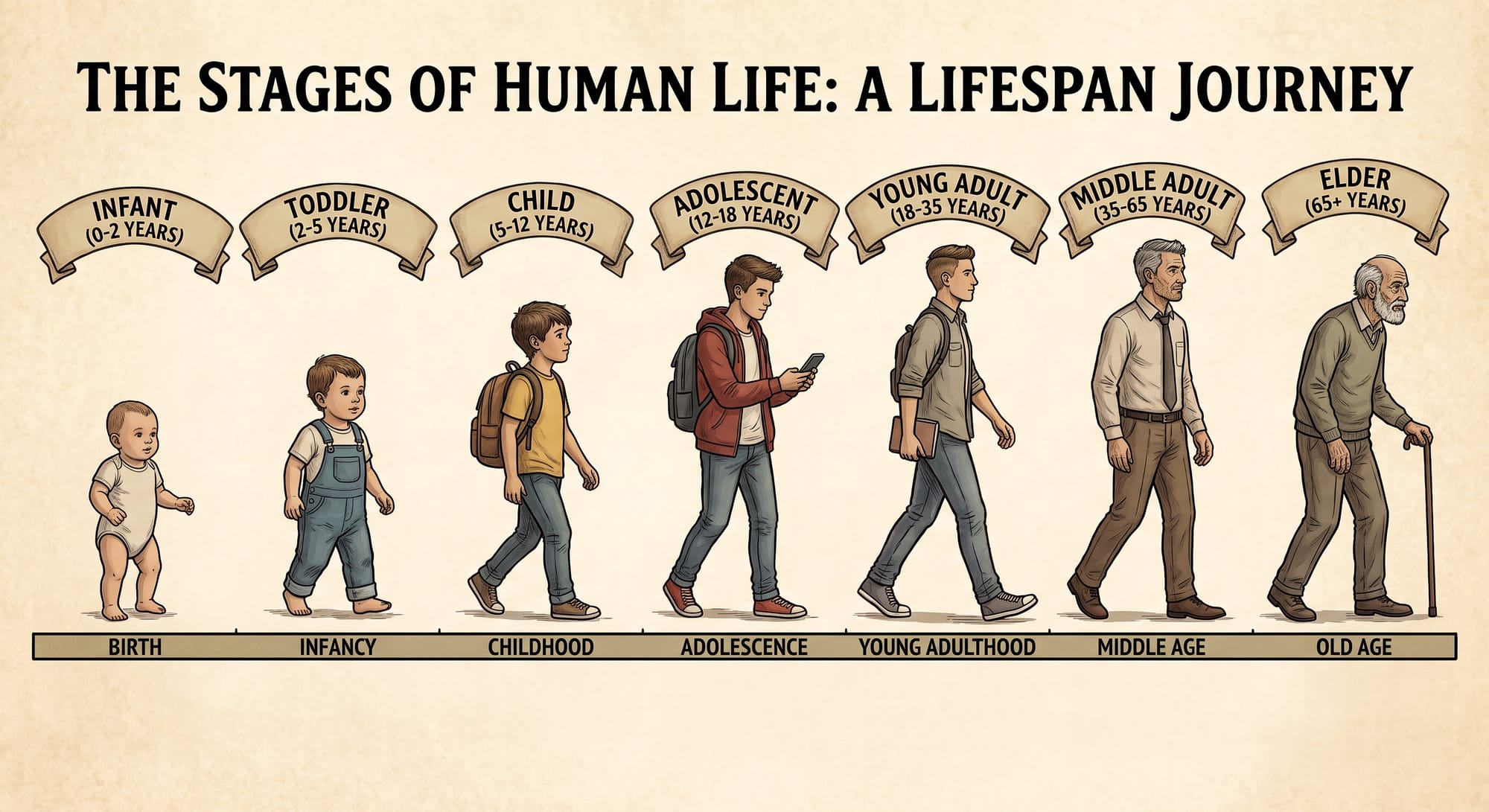
Just as all species go through different life stages, industries also go through different life cycles, sometimes over years or decades. The evolution speed depends on the type of underlying factors some of which accelerate the process - like
- Disruption due to software, AI etc which accelerate changes or
- Others which force changes over longer period - like demographic changes.
What does industry evolution mean? It means an industry can be at different stages of it's life cycle just like any biological organism. What are these stages?
The below diagram from Michael E Porter shows these stages :
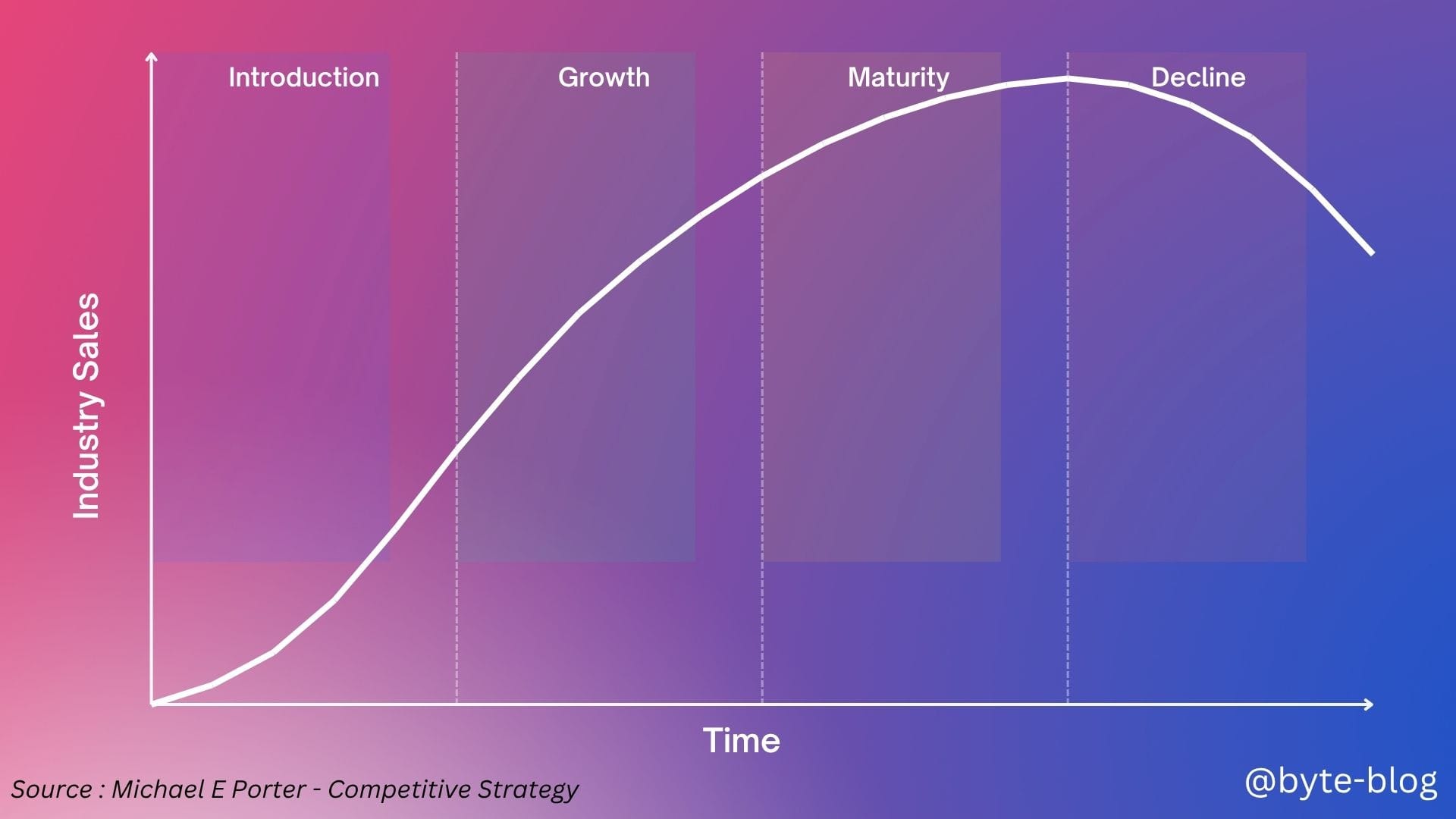
This is similar to a product life cycle where a product passes through different stages. Some key characteristics at various stages are given below:
- Introduction - When a new product is introduced - heavy investments in R & D, high marketing spend, Increase market share, High prices, low profits etc
- Growth - Sales grow, demand increases. Product differentiation, High marketing spends but decrease as a percentage of sales, High Prices & Margins.
- Maturity - Standardizing products, incremental changes only, Efforts to extend life cycle of existing products, Having competitive costs become key, Low Profits & Margins
- Decline - Low Profits & Margins, Falling Prices, Cost control is key, Low marketing costs.
Why is this important in the context of strategy?
This is because understanding the stage of an industry provides a company with important context to frame it's strategy. How?
- Understanding which stage an industry is in influences the attractiveness of an industry & in turn decision on allocating investments as part of a company's strategy. For e.g., a company wanting to enter an industry in introduction stage might spend a significant amount on research & development for product improvements while an industry in decline stage will not be an attractive destination for investments.
- An industry in decline may be in decline in it's current state but is evolving to a new state. For e.g., automobile industry where the traditional supply chain is evolving to accomodate new paradigms like batteries, EV charging stations etc. This impacts where the investments are directed to.
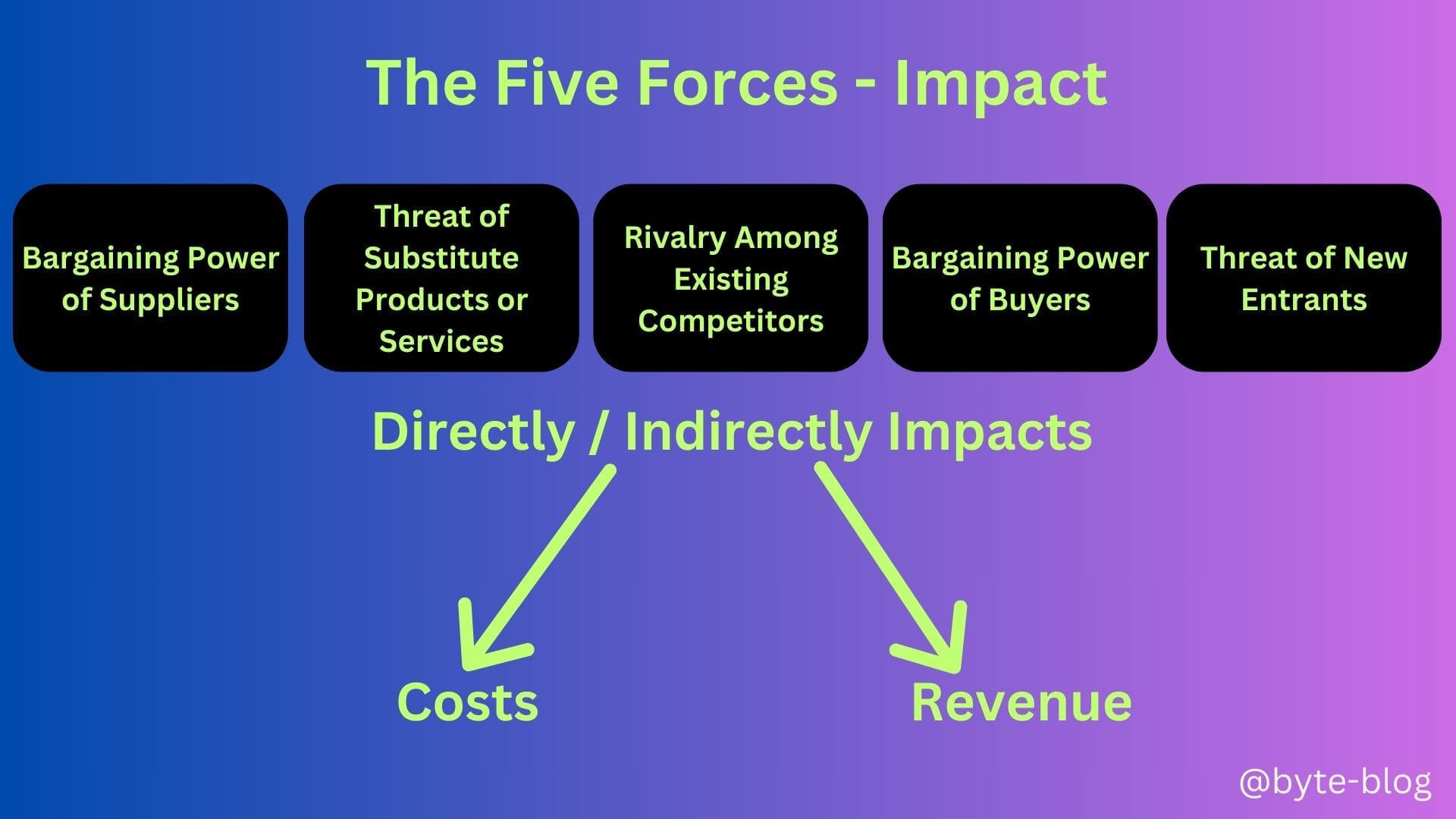
- The interaction of Five Forces will be different or evolve at each stage depending on the underlying trends affecting that industry. This in turn impacts the value captured by each player in the industry affecting it's revenue & costs or in other words - net profits. (As a recap, providing the link to Five Forces which we discussed in Week 75 & the image below).
- Understanding how an industry is evolving & at which stage it is in is critical in predicting changes so necessary action can be taken to benefit from those changes earlier as the cost of reacting to those changes increase as the window closes.
Every industry begins with a set of interactions between the Five Forces as it comes into existence. The evolutionary process work to push the industry towards changes as time moves forward. These changes are driven by the flow of investments & other underlying forces causing this evolution (described below). We can see that in the automobile industry (which we will again explore next).
The question that comes to mind next is - What causes these evolutionary forces?
Michael E Porter in his book "Competitive Strategy" has discussed some underlying reasons which differs from industry to industry as below :
- Long run changes - Demographics, trend in needs etc
- Changes in buyer segments served
- Buyers' learning
- Reduction in uncertainty
- Accumulation of Experience
- Product &/or Process Innovation
- Government Policy changes
- Entries & Exists
- Changes in Input
& many more.
Roger L Martin gave a different take on industry evolution classifying it from Pre-competitive to competitive. What does it mean?
He says that "Industries go through a particular transformation that typically isn’t obvious until after it happens. However, the transformation is deadly to most players that are there at its start."
Pre-Competitive
In pre-competitive industries, many competitors typically co-exist in a large market. Even though they are competitive for new business, there is always other business to win.
He gives the example of the strategy consulting industry - In the mid-1980s, the strategy consulting industry was pre-competitive. In addition to the largest competitors of the day, McKinsey, BCG and Bain, there were innumerable smaller firms competing, including his firm, Monitor, but also Corporate Decisions, Strategic Planning Associates, Oliver Wyman, Marakon, Parthenon, etc.

Competitive
When an industry crosses over from pre-competitive to competitive, some player — either from inside or as a new entrant — takes an action that precipitates a transformation, one that rarely stops after it gets started & endangers the survival of firms caught unaware. The action is to push a scale button in a way that makes remaining a small player nearly or entirely impossible.
He gives the example of strategy consulting industry - initially driven by McKinsey in the mid-1990s when they announced that it would spend a significant amount annually on R&D/product development an amount that happened to be equal to Monitor's (Roger Martin's consulting firm that time) total revenues. Then they built a low-cost analytical capacity in India & a Global Institute to build new IP.
All of these competitive weapons required scale that made it relatively easy for McKinsey, harder for BCG, harder still for Bain and impossible for Monitor-sized competitors. This was clearly an exercise in pushing the scale button in strategy consulting.
Now the industry is dominated by the consulting giants, McKinsey, BCG and Bain, plus the huge broad-based professional service firms, Deloitte (which absorbed Monitor), EY (Parthenon) and PWC (Booz).

Next week, we go one step further to identify the impact of the above evolution to value capture or profit pools.