Strategy Byte - Week 84 The Evolution Part 1

Table of Contents
- Recap
- The Evolution
- 1900's
- 1910's
- 1920's
- 1930's
- Sources & Citations
Recap
During Week 83, we started our deep dive into automotive industry analysis by starting with mobility. What is mobility?
Mobility refers to " the set of solutions that enable the movement of people and goods in an efficient, sustainable and accessible manner. "
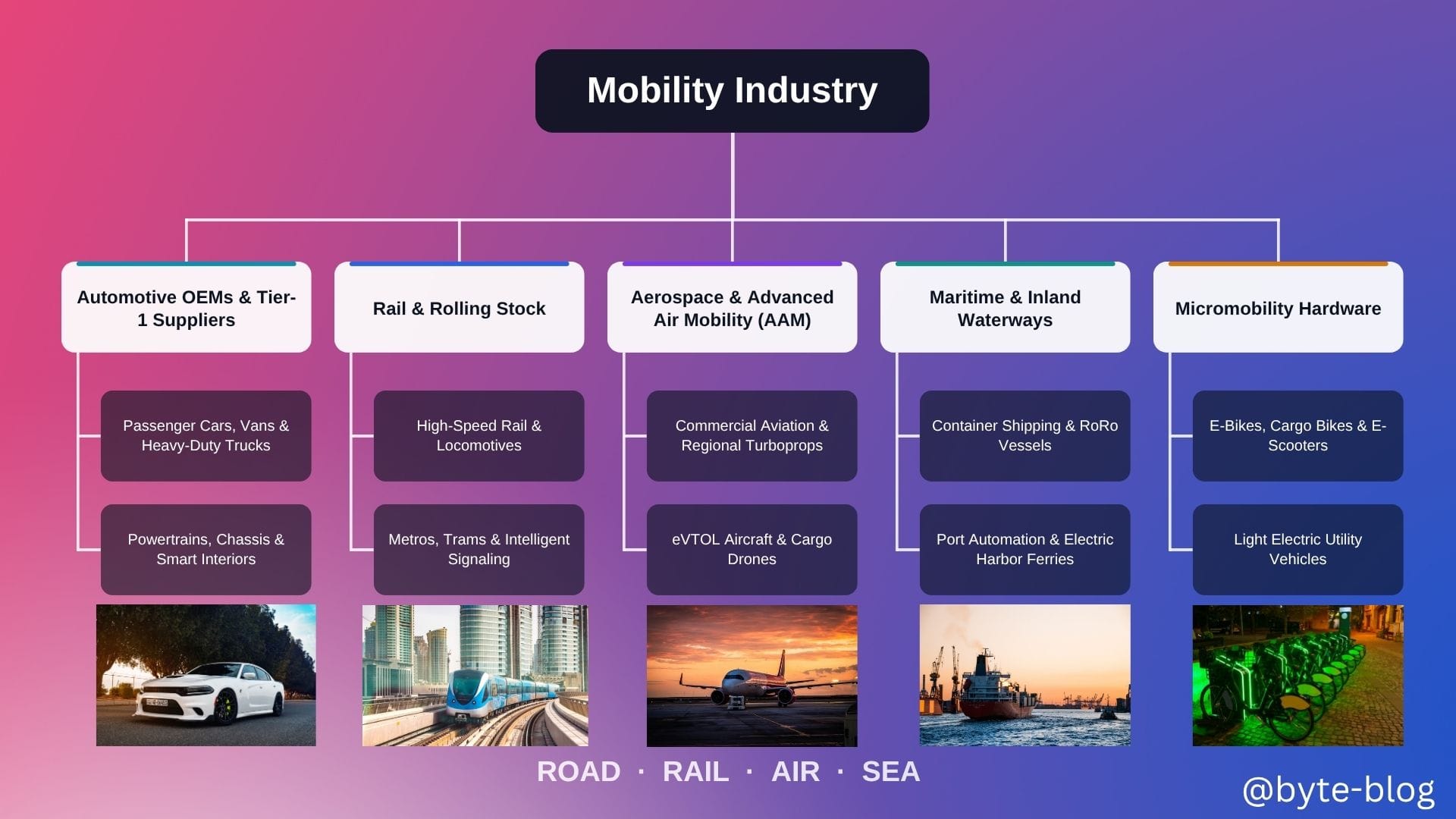
The Mobility Industry includes the below :
- Automotive OEMs & Tier-1 Suppliers: Passenger cars, commercial vans, and heavy-duty trucks, alongside chassis, powertrain, and interior systems suppliers.
- Rail : High-speed rail, locomotives, freight cars, metros, trams, and signaling systems.
- Aerospace : Commercial aviation, regional turboprops, unmanned aerial vehicles (cargo drones), and electric vertical takeoff and landing (eVTOL) aircraft.
- Maritime & Inland Waterways: Container shipping lines, bulk carriers, roll-on/roll-off (RoRo) vessels, automated port handling equipment, and electric harbor ferries.
- Micro-mobility Hardware: E-bikes, cargo bikes, e-scooters, and light electric utility vehicles.
Visualizing the above :
Then we explored the history by seeing what was the mode of transport before it all existed - horse carriages, street cars etc.
We then explored how horses were disrupted by cars which were "initially perfected in Germany and France toward the end of the nineteenth century by such men as Gottlieb Daimler, Karl Benz, Nicolaus Otto and Emile Levassor"
Why did the car win? It came down to cost, and convenience. A car took people from place to place on their own timetable and once mass production made it affordable, the horse could not compete.
This week, we explore the evolution of the automotive industry from 1900's to 1930's.
The Evolution

To give a structure to our discussion on automotive industry evolution, we will discuss it under five headings in blocks of a decade:
- Technology - What was the technology used & what new came up during the period under discussion which led to newer models &/or facilities in the car
- Market - What was the market position of the automotive industry during the period
- Business & Operating Model - What was the business & operating model of the auto makers during the period
- Rules & the State - Major regulations introduced during the period
- Companies - Who were the companies in the news & their major activities during the period
Let's go on a time travel

1900's

Technology
The modern motorcar arrives. The Model T launched on 1 Oct 1908, built light with vanadium steel and few extras.
The Market
The market had limited reach & was small. US registered cars went from 8,000 to 77,400 over 1900–05. France out-produced the rest of Europe according to the Lane Motor Museum until the US passed it after 1907.
Business & Operating Model
The business model was developing in the early stages of the automotive industry. Cars were still built in small numbers; Daimler used about 1,700 workers for fewer than 1,000 cars a year. Makers increasingly assembled bought-in parts. Carmakers often sold direct, and Ford ran company-owned branch stores; dealer franchises emerged to sell, finance and service cars . The Model T sold for $825.
Rules & the State
Connecticut passed the first US state law regulating motor vehicles in 1901, a speed limit of 12 mph in towns and 15 mph on country roads. States brought in driver licences from 1903 (Massachusetts, Missouri).
Companies
US makers peaked at 272 in 1909. Ford was founded in 1903 and GM in 1908; Fiat was founded in 1899; Opel began making cars in 1899 and Vauxhall in 1903.
1910's

Technology
Cadillac’s electric starter came in 1911. Ford’s moving assembly line (1913) cut chassis labour from 12.5 hours to 2 hours 38 minutes.
The Market
US registered cars rose from 458,377 to 8,131,522 over 1910–20. The US built about 485,000 of the world’s 606,124 vehicles in 1913, while in 1910 Germany had “barely 16,000” cars on the road (VW chronicle).
Business & Operating Model
- Moving lines spread to other makers by 1916, and Ford paid $5 a day.
- Ford stopped selling direct. In Britain it used non-exclusive dealers who could adapt the cars to local tastes.
- Buying on instalments began in 1916, and GM set up its finance arm, GMAC, in 1919.
Rules & the State
- Ford began building in Manchester in 1911 because shipping finished cars was costly and “protectionist tariffs loomed” (Tolliday).
- Britain’s McKenna duty put 33⅓% on imported cars from 1915.
- The US Federal Aid Road Act (1916) funded rural roads.
Companies
Ford and GM made 38% of US output in 1911. In 1914 Ford built 260,722 cars against 286,770 for all other US makers combined. Peugeot’s Sochaux plant opened in 1912, and Citroën’s Type A came in 1919.
1920's

Technology
Closed cars push out open ones. Citroën says its B12 had Europe’s first all-steel body in a series car (1925, claim). The Model T ended in 1927; retooling for the Model A meant replacing about 15,000 machine tools.
The Market
The US made 86.3% of the world’s 27.8m cars over 1923–28. By 1927, buyers replacing a car outnumbered first-time buyers.
Business & Operating Model
- GM’s approach of a car “for every purse and purpose”, annual model changes and its own credit arm beats Ford’s single model.
- Ford’s Weekly Purchasing Plan (1923) was not very successful, while about three-quarters of new cars were bought on credit by 1925.
- Ford pushed unsold Model Ts onto its dealers in the 1920 slump, whereas Sloan says he gave dealer relations “a large part of my attention”.
- Fiat’s Lingotto plant opened in 1923, and Opel put in Germany’s first assembly line in 1924.
Rules & the State
The US Federal-Aid Highway Act (1921) settled highway policy. Britain kept the McKenna duty after the war. Rising British tariffs and car taxes pushed Ford’s Manchester plant to buy parts locally and favoured smaller, economical cars.
Companies
Ford held 55.67% of the US market in 1921 and GM 12.73%, and US makers fell from 88 to 20 by 1929. Chrysler was formed in 1925 and bought Dodge in 1928. Daimler-Benz was founded in 1926, and Morris and Austin had 60% of the UK market by 1929.
1930's

Technology
Ford’s V-8 (1932), Peugeot’s independent front suspension (1931), Citroën’s front-wheel-drive Traction Avant (1934), Opel’s unibody Olympia (1935) and Mercedes’s 260 D. Chrysler’s streamlined Airflow sold poorly.
The Market
US registered cars stalled at 23.0m (1930) and 22.6m (1935), then reached 27.5m by 1940. The UK market grew from 182k to 305k units, and Japanese output from 437 to 34,515 vehicles.
Business & Operating Model
- US dealer agreements ran year to year, and carmakers could cancel them.
- Ford’s V-8 was priced above Chevrolet, at $505 against $485 (1934). “Yearly models” changed the market (O’Brien).
- Toyota set up an instalment-finance company in 1936.
Rules & the State
- Japan’s 1936 law subsidised Toyota, Nissan and Isuzu.
- Germany sold its people’s car through a savings scheme at a “politically determined” price. 336,638 people signed up, and no saver had received a car by the war’s end.
- France: Citroën says that, at the government’s request, Michelin, its largest creditor, took over its financial restructuring.
- US: Wisconsin passed the first state dealer law (1937), and a 1939 FTC report called dealer franchises unfair. The auto code under the 1933 National Industrial Recovery Act, as amended, told makers when to bring out new models.
Companies
Most US independent makers were wiped out. In 1936 GM claimed 43% of the US market, Chrysler had 25% and Ford 22%, and 9 US makers were left by 1941. Citroën stayed in financial trouble, and André Citroën died in 1935. Auto Union (1932), Toyota (1937) and Nissan (1934) were formed.
Sources & Citations
Research papers and official records
- Cheng et al., NBER Working Paper 26121, 2019 (rev. 2022)
- Congressional Research Service, Report R40712, 8 Jan 2010
- Cooper & Haltiwanger, NBER Working Paper 4100, 1992
- de Bromhead, Fernihough, Lampe & O’Rourke, NBER Working Paper 23164, 2017
- Eli, Hausman & Rhode, NBER Working Paper 31454, 2023
- Fabricant, NBER, 1940
- FHWA, Contributions and Crossroads timeline
- FHWA, Highway Statistics Table DL-230 (state driver licence laws)
- FHWA, Highway Statistics Table MV-200 (motor vehicle registrations)
- Fujimoto & Tidd, Actes du GERPISA no. 11
- Hounshell, NBER, 1999
- Klepper, 2001
- Loeb, Business and Economic History, 1995
- O’Brien, Business and Economic History, vol. 18, 1989
- Raff, NBER, 1995
- Tedlow, Business and Economic History, vol. 17, 1988
- Tolliday, Actes du GERPISA no. 11
Carmakers’ own histories
- Citroën (Stellantis), 100 years of Citroën: company history (German)
- Citroën (Stellantis), Centenaire de Citroën, 21 May 2019
- Citroën (Stellantis), 100 Jahre Citroën: Traction Avant, 27 Jun 2019
- Fiat (Stellantis), Fiat: a hundred-year history (German)
- Ford Motor Company, Assembly Line Revolution
- General Motors, GM Heritage
- Mercedes-Benz Group, 100 years of the Mercedes-Benz brand
- Mercedes-Benz Public Archive, 260 D (W 138), 1936–1940
- Nissan, Heritage: 1930s
- Opel (Stellantis), Opel celebrates 120 years of automobiles
- Opel (Stellantis), The Opel Laubfrosch, 100 years ago
- Opel (Stellantis), 90 Years of Opel Olympia, 3 Mar 2025
- Peugeot UK, Brand history
- Toyota, 75 Years of Toyota: 1937
- Toyota, 75 Years of Toyota: Establishment of Toyota Motor Sales Co., Ltd.
- Vauxhall (Stellantis), Vauxhall Heritage
- Volkswagen Group, Chronicle 1904–1933
- Volkswagen Group, Chronicle 1934–1937
- Volkswagen Group, Chronicle 1937–1945
- Volkswagen Group, The history of Audi
Other