Strategy Byte - Week 68 The Journey so far Part VIII

Table of Contents
- Recap
- Market
- Competitive Market
- Price
- Demand
Recap
We continue our journey to understand strategy by looking back & reviewing our steps which will help us gain perspective on the subject & also guide us moving forward.
Last week, we discussed Fiscal Policy which we initially covered in Week 32 to Week 34.
Fiscal Policy is the means by which the Government adjusts it's budget through spending & revenue changes to influence broader economic decisions.
Then we covered Government Revenue & Government Expenditure & how fiscal deficit or fiscal surplus is managed :
- When an economy is performing well but has a risk of overheating, cooling measures are initiated like increasing taxation, reducing spending etc. This policy is called Contractionary Fiscal Policy. This is because increased taxation & reduced spending will leave less money in consumer pockets which will cool down demand for goods & services which in turn will cool business activity resulting in lower employment etc.
- When an economy is not performing well, measures are initiated to stimulate the economy through tax cuts, increased spending etc. This is called Expansionary Fiscal Policy. This will result in more money in consumer pockets for them to spend, increasing demand for goods & services which in turn increases business activity, higher employment etc
All the macro economic variables that we discussed over the last couple of weeks affect something important which economists refer to as Supply & Demand. We deep dived into supply & demand from Week 36 to Week 39.
Before we revisit supply & demand, let us take a step back to understand Market & Price which we discussed in Week 35. Let's go....

Market
A market is any place or venue where buyers & sellers can exchange goods & services.
A market may be
- Physical - like a retail outlet or
- Digital - like an online store (e.g., Amazon)

From the above definition, we can infer that :
- A market is a place that enables buyers & sellers to exchange goods & services which means a market has two sides - buyers & sellers
- There are markets for goods such as oranges, appliances, raw materials etc
- There are markets for services such as online courses, haircuts, professional services etc.
- Physical markets enable buyers & sellers to meet & conduct business
- Virtual / online markets enable buyers & sellers who never meet or know little about each other to connect with each other online to conduct business
With the above in mind, let us understand what is a competitive market.
Competitive Market
A competitive market is a market where there are a large number of buyers & sellers but no single buyer or seller can influence the price of goods being sold.
It's a well known fact that competition drives prices down to an equilibrium price.
But then, what is price?
Price
There are two kinds of price in economics :
- Money Price
- Relative Price
The price of a good or service is the amount of currency that is given up in exchange for that good or service. This is called Money Price.
Relative Price is the price of a good or service compared with or relative to another good or service.
However, as in life, there are constraints related to :
- Resources - Money available to spend &
- Supply of goods - The goods that we want may not be available in unlimited quantities.
So, we want to allocate our limited resources to something that we perceive to satisfy our needs best. For e.g.,

There are apples & oranges. Assume one apple costs $ 2.00 & an orange costs $ 4.00. So,
Cost of 1 orange = Cost of two apples
Now, with limitation of resources (money), assume we can buy only one item - apples or oranges. If we decide to buy one orange, we sacrifice two apples. The two apples sacrificed is called the opportunity cost.
Thus, based on our preferences & resource constraints, there is a trade-off involved in our decisions to spend money or in other words, allocate resources where gains are maximized - resource allocation.
Assume a situation where the demand for oranges goes up increasing their price & the price of apples remain the same. The price of oranges would go up relative to apples which means the relative price of oranges goes up.
The consumers will buy either apples or oranges depending on their preferences at that point in time. If someone feels that oranges are too expensive, they will go for apples. This can also impact suppliers' decision to grow more oranges instead of apples.
Thus, the concept of relative pricing helps consumers & producers make informed decisions about resource allocation to spend or produce in line with their preferences.
With this understanding of market & relative prices, let us revisit our discussion on Demand & Supply.
Demand
Demand is : The desire or need of customers for goods or services that they want to buy or use.
If we demand a good or service, it means that we want it. But then, it is not enough that we want something. Why? As we mentioned earlier, there are constraints around resources & in this case, that resource is money.
With limited money, there are constraints around what we can afford even though we may want something or there is a demand for that item. Thus, we should be able to afford that good or service.
Thus affordability is a key factor in demand. For e.g., a consumer may want a Lamborghini. So, there is a demand. But not all can afford a Lamborghini.

Assuming we can afford the item that we want, we should have a plan to buy it. If we don't have a definite plan to buy something, then we cannot say that there is a demand for that item.
So there are three aspects to demand :
- There should be a want for a good or service
- The good or service should be affordable &
- There should be a plan to buy that good or service
There are two variables used to measure demand. They are :
- Quantity
- Price
The quantity demanded of a good or service is the amount that customers plan to buy during a time period. It is normally measured as an amount per unit of time.
The price is the amount at which the quantity demanded is bought or purchased.
Factors affecting Demand
There are five factors which drive demand :
- Price of good / service
- Consumers' Income
- Consumers' tastes & preferences
- Prices of related or substitute goods
- Expectations of Price
Representing the above visually :
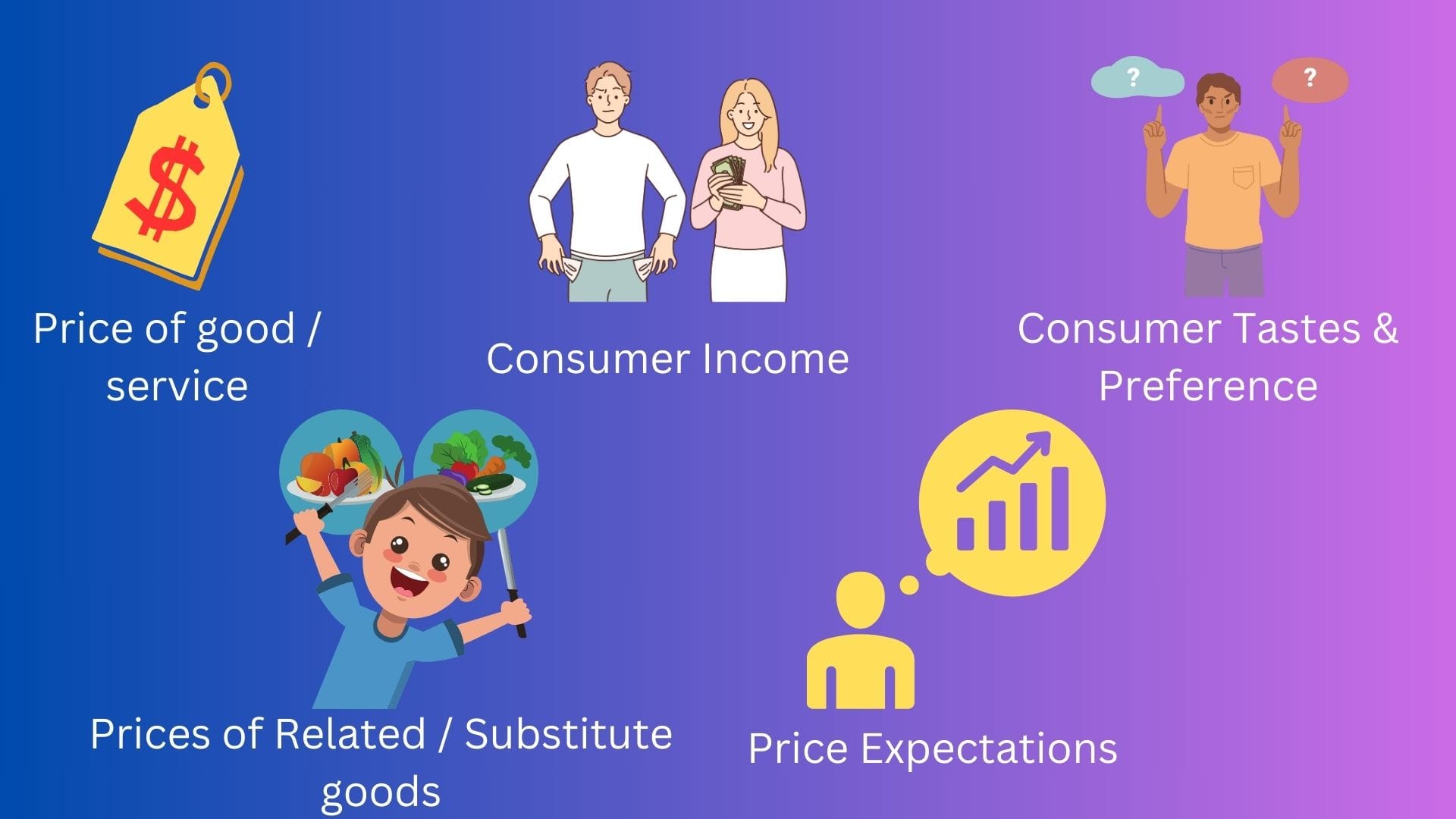
Thus, there are multiple variables at play driving demand of a good or service. However behind the scenes, there is a pattern driving the inter-play of these variables. Next week we will look into these patterns under
- Law of Demand &
- Demand Curve