Strategy Byte 78 – The Other side of Value
The firm's side of the value equation: cost of value creation, willingness to sell, the value chain and how firms capture value.

Table of Contents
- Recap
- Value - The Firm Equation
- Cost of Value Creation
- Willingness to Sell
- Value Chain
- Value Capture
Recap
During Week 76 & Week 77, we explored value from the perspective of a customer. What does value look like to a customer? The look & feel, the user experience or utility?
A math equation has two sides. Using that analogy, we looked at one side of the value equation - the customer perspective.
From a customer perspective, it is more about
- increasing a product / service utility & improving customer experience
- which makes them assess the value of the product or service
- at a higher level than how they perceive & value their competitors' products / services.
This means, in simple terms, increasing a customer's Willingness to Pay (WTP).
The WTP value is the most a customer would pay for a product or service & a company which finds ways to improve their product or service increases it's WTP value
We looked at the example of Apple vs Windows laptop analyzing how Apple's differential pricing across it's laptop models is proof of differential value as customers perceive it.
Now, we look at how value is perceived from firm perspective
Value - The Firm Equation
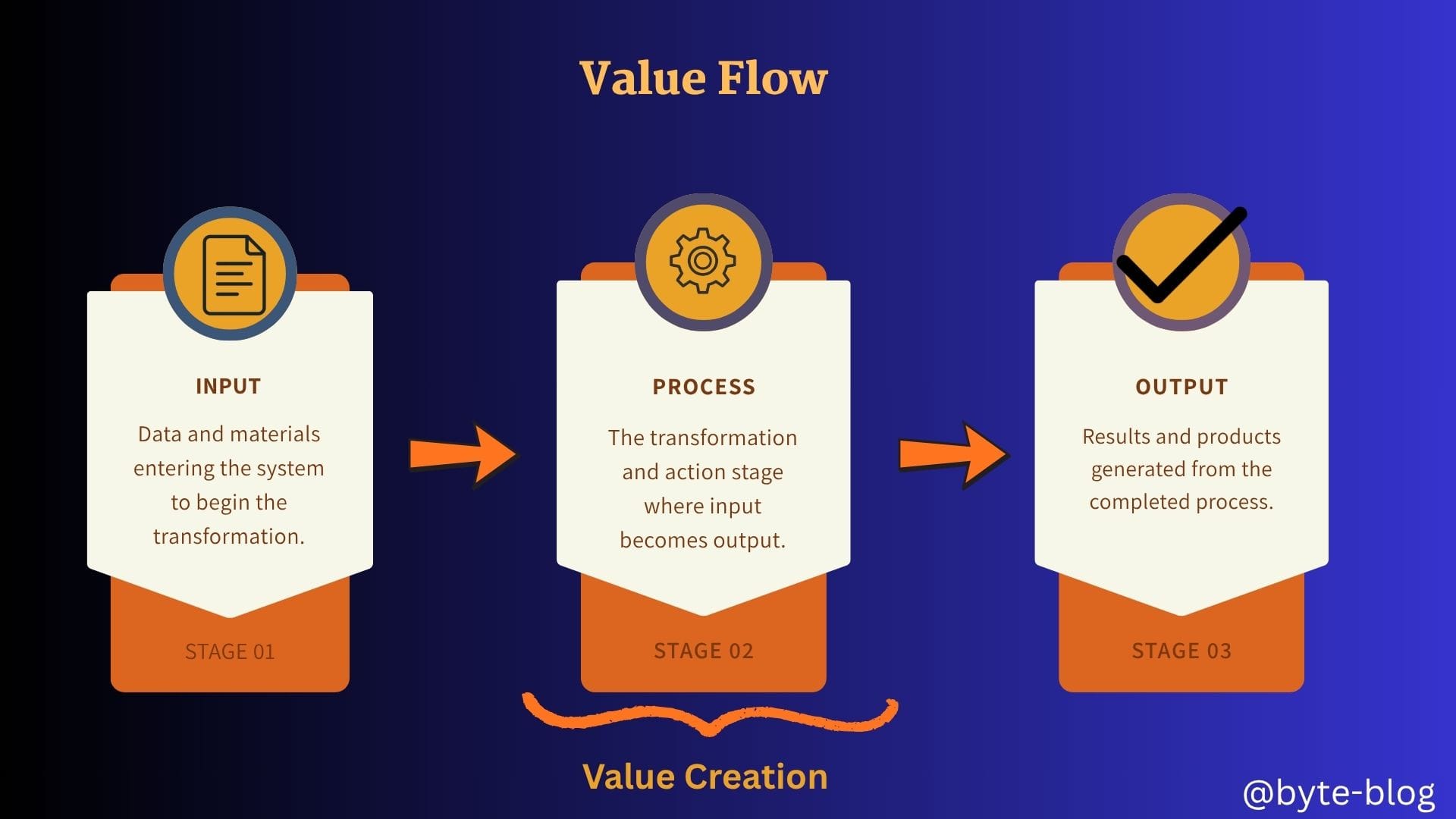
The most simplest way we can think about value from a firm's perspective is the below process chart :
A firm or service provider
- Procures inputs,
- Carries out process(es) to convert those inputs into output.
- Delivers the final output
The process of converting inputs to a desirable end output is where value creation happens.
The end objective depends on
- A problem statement or
- Improving an existing situation making it better from the customer's perspective or from the firm's perspective or
- Creating an entirely new paradigm where a product or service is introduced where none existed earlier. Remember how the Iphone changed the paradigm of phones?

One important point to note is that, like Karma, there is a cost element to value creation. What does this mean?
The other side of the equation holds the variables related to a firm producing the product or service.
Let us dive deeper into this aspect of value creation

Cost of Value Creation
Nothing is free in life. Everything has a cost. So, when a firm gets some input & creates an output using set processes, there is a cost involved in
- procuring resources &/or
- running the processs
creating the output or in other words, value creation has a cost.
So, for a firm, there are two parts to it :
- Value Creation by improving customer experience &/or utility
- Cost of the value creation
Felix Oberholzer-Gee in his book "Better, Simpler Strategy" (Check out his interview below) has an interesting concept around the cost part of the value equation called "Willingness to Sell".
What is Willingness to Sell?
Willingness to Sell
We discussed "Willingness to Pay" (WTP) over the last two weeks. If we consider that as one end of the "value stick" (From Better, Simpler Strategy), Willingness to Sell (WTS) is the other end of the value stick which is the cost part of the equation where a company pays to procure the input. There are two touch points here :
The touch points for WTS for a firm are :
- Employees &
- Suppliers
WTS is the minimum compensation an employee requires to accept a job offer & for suppliers, WTS is the lowest price at which they are willing to sell products & services.
So, at one end a company increases the willingness to pay from the customer end by improving the utility &/or experience of the product or service & at the other end, reduces the willingness to sell by improving the work experience for the employee to ensure they negotiate for the lowest remuneration to work for the company &/or improve relationships with suppliers to ensure they supply their products or services at the lowest price.
We can visualize all the above three players (Supplier -> Firm -> Customer) using the value stick (From Better, Simpler Strategy by Felix Oberholzer-Gee & The Strategist by Cynthia Montgomery) as below :
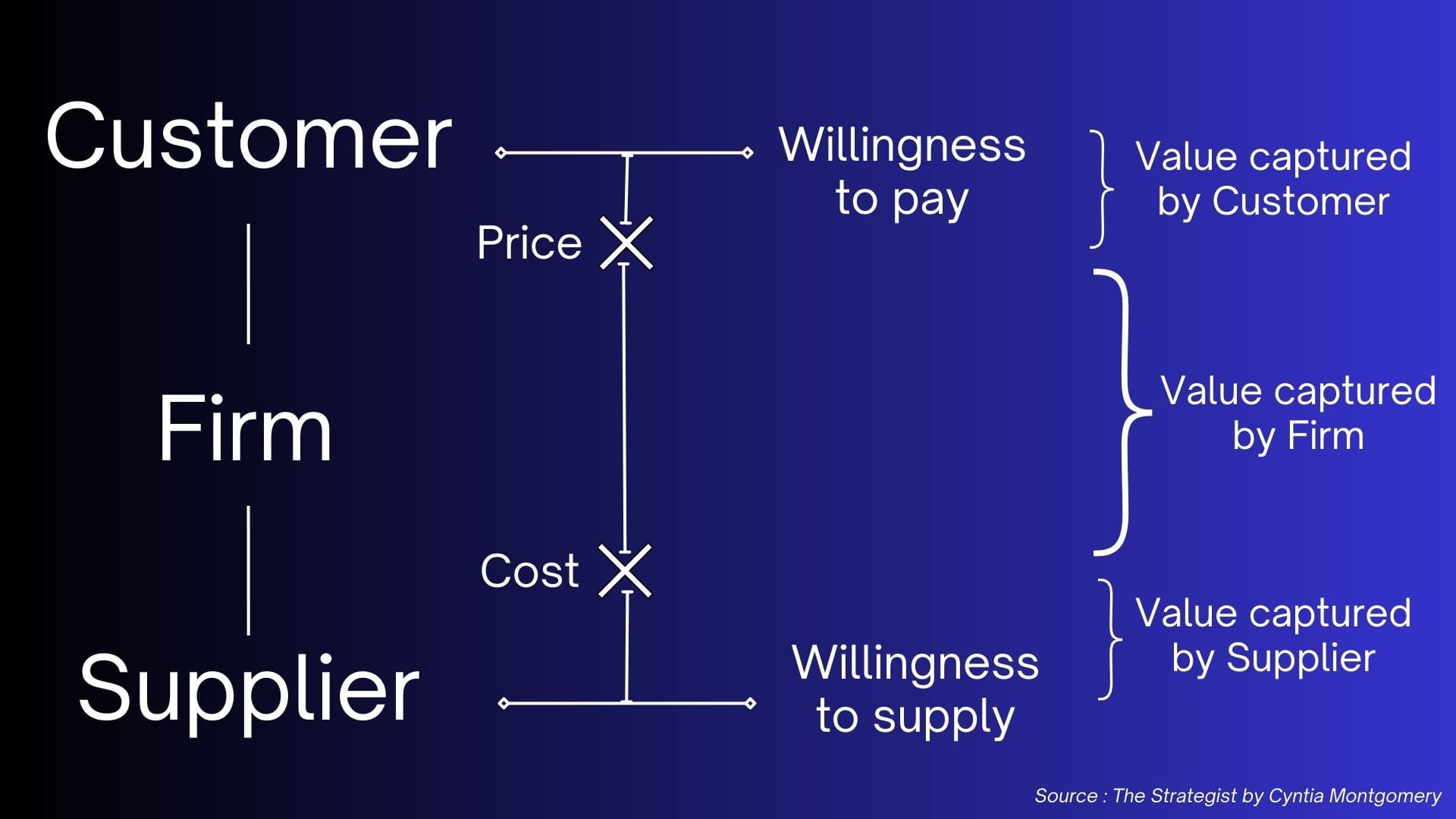
Each player creates value at different stages of the product or service cycle. This value is then captured by each player through pricing their respective output (We will cover this point below).
So, for the firm, the maximum value capture happens when the WTP is increased & WTS is reduced. Visualizing the above :
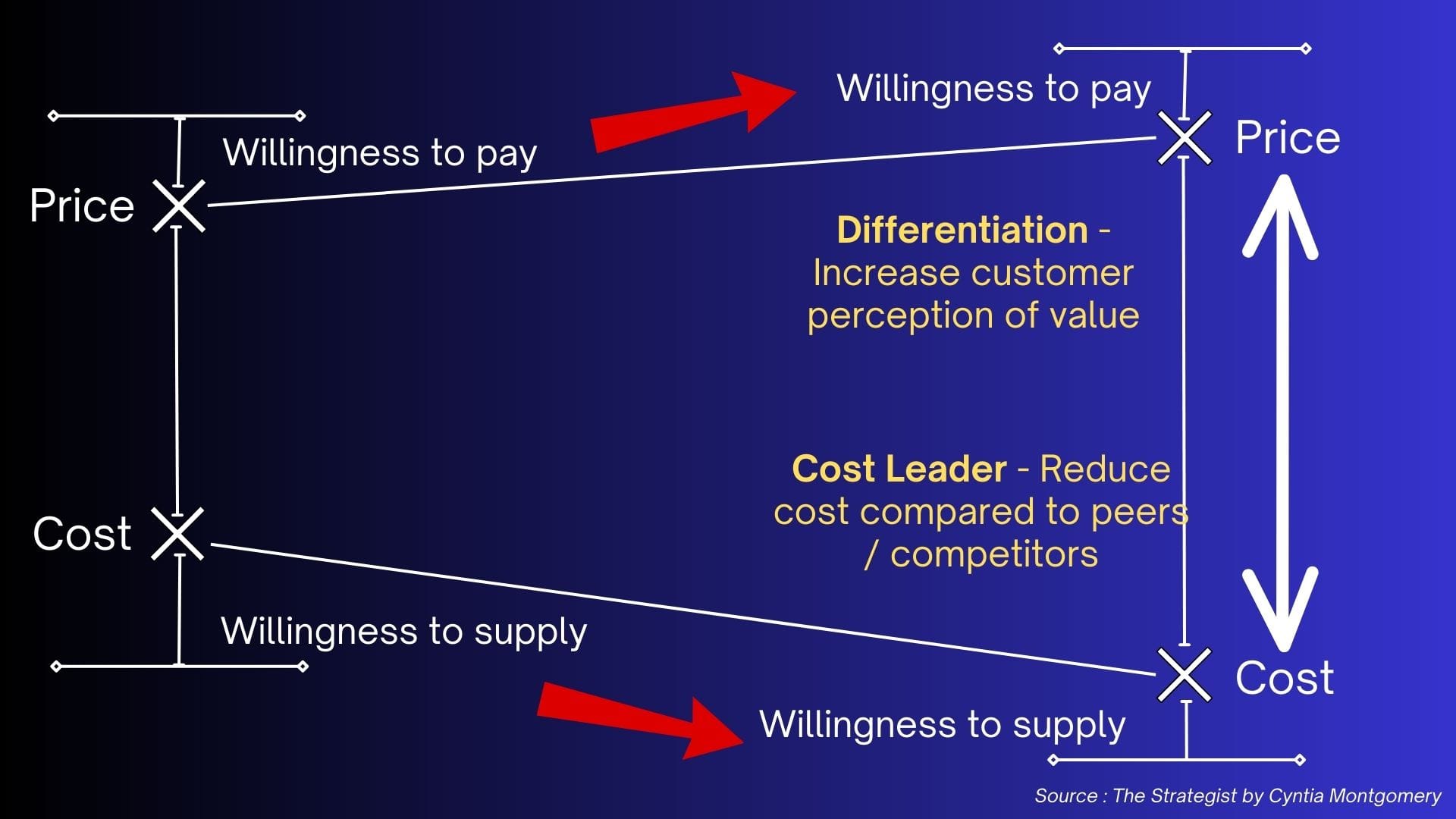
The strategy of a firm should try to target increasing WTP & reducing WTS to maximize the value capture.
With the above in mind, let us now deep dive into the next framework around value - Value Chain by Michael E. Porter
Value Chain
We covered Value chain in Week 48. But we will cover it here again as it is another framework which we will use to cover value addition.
The term "Value Chain" was first presented by Michael Porter in his seminal & influential book Competitive Advantage - Creating & Sustaining Superior Performance.
He identifies Value chain
- as a set of activities
- that a firm performs
- to deliver a valuable product or service to the market
In simple terms, a company gets input of raw materials => processes those raw materials => converts them into finished products. All those processing & conversions happen through a set of activities which is called a "Value Chain".
A value chain can be broken down into five primary activities :
- Inbound Logistics - receiving raw materials, warehousing, and managing inventory etc
- Operations - all activities in the process of converting raw materials into a finished product or service
- Outbound Logistics - delivering the final product or service to the end user
- Marketing & Sales - all strategies and activities aimed at incentivizing potential customers to purchase the final product or services, including distribution channel selection, advertising, and pricing
- Post Sales Service - all activities that intend to improve consumer experiences, such as customer services, repairs, or maintenance services
A Value Chain could also include secondary or support activities that facilitate the efficiency of the primary activities, such as procurement, technology research, product development, HR etc.
Porter notes that these activities form a firm’s value chain, each creating and adding value at every stage toward the end product or service. He suggests that a firm must understand its own value chain to develop and sustain a competitive advantage (Porter, 1985).
The Value chain concept can be visualized as below (Source : here)
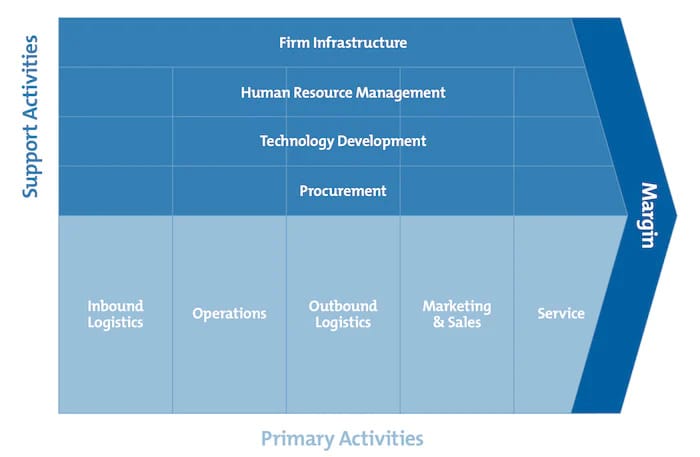
Each part of the value chain contributes to value add one way or the other resulting in the total value add to customer. It is important to understand how much of that value is captured by
- The Customer
- The Firm &
- The Supplier
Value Capture
The value creation process by a company or firm has meaning only if it is able to capture that value. So if a firm is not able to capture the value they created, then those actions have no meaning.
How is value captured ? A firm captures value through proper pricing of it's products or services.
Visualizing the two sides of the equation (figures quoted are imaginary):
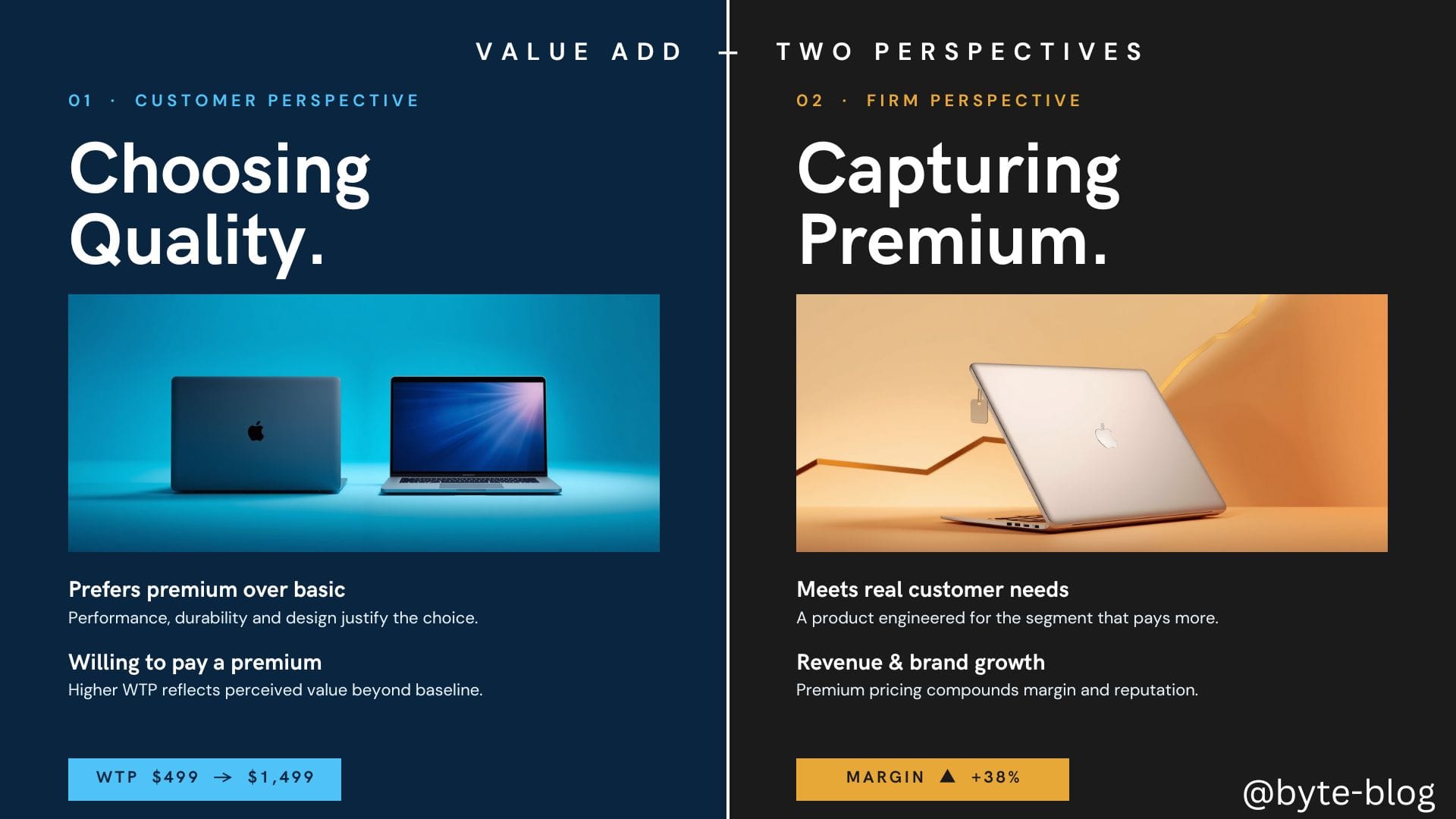
How do we measure this value capture? This is where we finance professionals come in trying to quantify value :
- How does value convert to Return on Invested Capital (RoIC)?
- Is the strategy consistent with maintaining & increasing value to customers which ultimately shows in returns?
- How is cost or willingness to sell being managed in a way that value creation & capture is maximized?
- How does this value capture translate to firm value?
A Finance professional sees the results of how both ends of the value stick (From Better, Simpler Strategy) are managed to ensure value maximization & ultimately increasing Return on Invested Capital (RoIC) & Firm Value.